
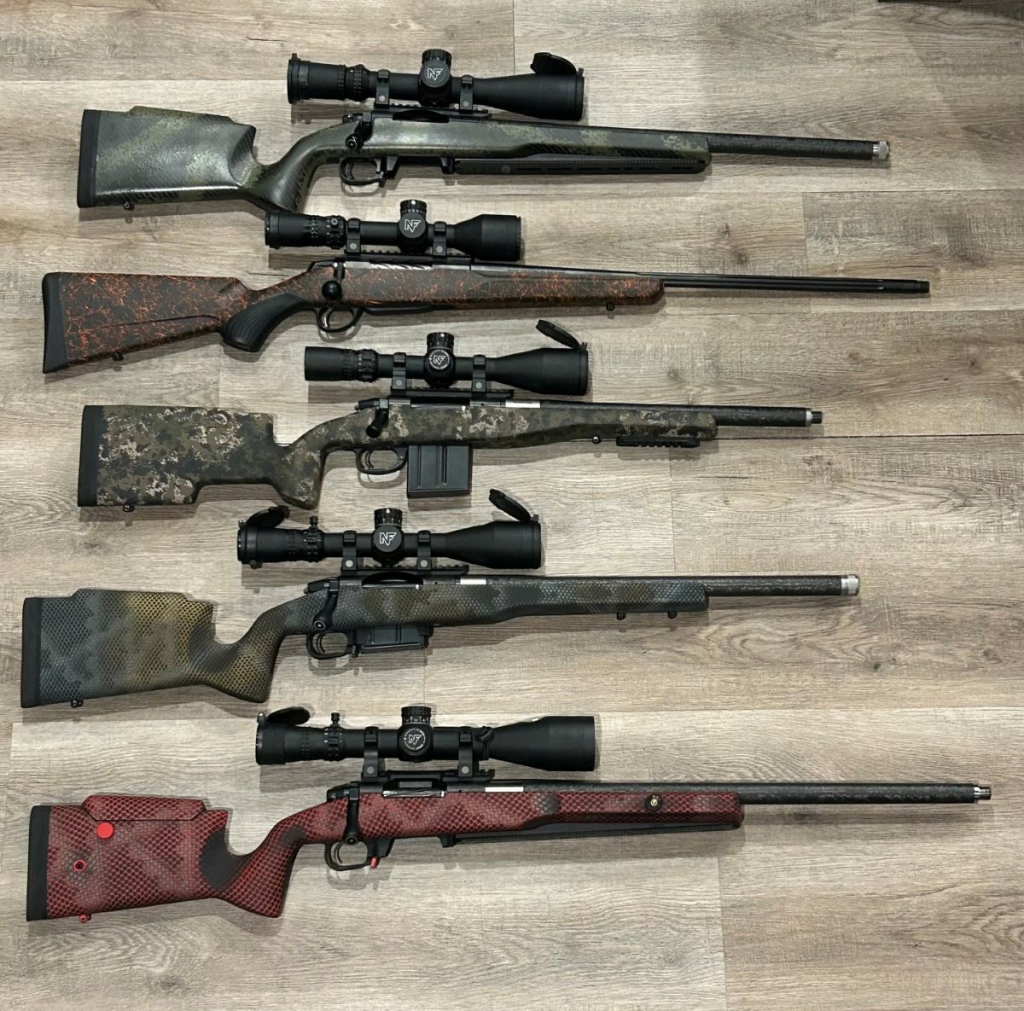
Every year starts a little bit different, but there’s always a common thread floating through all of it. It’s the anticipation of hunting season, and the preparation that it requires. It’s something I truly look forward to. It’s the time spent lovingly deciding which rifles are making this year’s cut, along with what bullet I’m going to use for each of them. It’s a process that includes a lot of time spent wondering what shape the year will take. But there’s also the technical side of the prep, thinking through what scenarios I might experience, and what bullet, cartridge, and rifle it will take to be successful. It really is an exercise I relish!
There was a time not too long ago when the battery itself was pretty extensive. I’ve always had a fairly emotional attachment to these inanimate objects, but that has begun to change over the last few years. It used to seem that every time I would walk into a gun shop, some rifle was pretty likely to follow me home. I called them my children, and honestly, the ones that have earned their keep still feel very much like that to me!
Why the Rifle Battery Changed
At one time not so long ago, I had a lot of collectible rifles. There were a lot of guns I had always admired, and as I’ve gotten older, I was finally in a position to start owning some of those rifles myself. But I actually remember the day my focus started to change. I had spent some time thoughtfully building some ammo for several of these old collectible rifles, and I took that battery to the range and started shooting them; the accuracy was absolutely underwhelming. I mean, perfectly usable in the hunting realm, but just not the level of accuracy I’ve become accustomed to. It kind of follows the thread I’ve been talking about in other articles, where today’s rifles, bullets, and barrels have all become so good that sometimes we start taking the level of accuracy we can achieve for granted.
When I got home from the range that day, it solidified a direction I had already begun going. I still love those old rifles and can appreciate them immensely, but I don’t need to own them anymore. It made me realize that what I really desire are rifles that earn their keep by having the level of precision that fuels my imagination. That type of rifle is what really drives me today, so I’ve started shifting my collection toward high-end precision rifles.
Since the battery of rifles these days is much narrower, there are a lot fewer to take along, but it creates its own unique dichotomy. I mean, I still have way too many rifles; I don’t want to mislead you about that, but the really precision-oriented rifles that really drive my imagination don’t overflow out of my safe, so every one of them is kind of screaming at me already, “take me, take me, Dad!”
How I Pick the Rifles
These days, another driving force is at work as well. I shoot a lot. I mean a whole lot, and if you’ve read much of what I’ve written, you know I’m not exaggerating. That amount of shooting is always driving my curiosity about which projectiles are going to accomplish the goals I want each year. I do really overplan this part. Most of the time I’m hunting in Texas, and for the most part the shots I might take are limited to a couple hundred yards. I do have one blind that I can conceivably shoot as far as 400 yards, but that’s the exception. But I also never know when I might get invited to hunt another ranch or, like last year, have a hunt planned somewhere where I know more range might be required.
I’m not just looking at range, though. I’m also thinking about what I want a bullet to do, and there’s also the testing side of my personality. I always want to see how things work, and having a professional relationship with Barnes/Sierra, there are always new bullets screaming at me that need to be thoroughly vetted and tested.
It’s these factors that drive the fun I have prepping for a new season: thinking through all the different scenarios I might run into, resolving that against the bullets I might want to shoot, and then picking the rifles that go along with those bullets.
But that’s not all. As all of this starts to take shape, I’ve got to load the ammo, then get it to the range and validate it. For me, that validation process isn’t just about getting them sighted in. I mean, the first real goal is getting a super solid zero, and then I’m going to go build a ballistic profile and shoot those systems out to some obscene ranges, just to make sure I trust them. It’s a process, and it doesn’t happen overnight.
This is what’s happening when I open the safe door and start doing a mental inventory of what’s there. I’m thinking through all these different things as I look at each rifle. Sometimes I come at it from the opposite side too, and the bullet itself helps determine which rifle gets selected. We should look at this year’s battery to see what I’m talking about, and how I came to my decisions. The interesting part of all this is that these decisions are also always in flux. There are always more bullets and rifles than I have time to test, and as I get older, I just don’t shoot as many animals as I once did. But the solidifying part of this process is that, in the end, I want to be able to have anywhere from four to eight rifles ready to go at a moment’s notice. I want to be able to open that safe door in the morning and ask the question I posed in my title: “Okay, kids, who wants to come with me today?”
This Year’s Hunting Rifle Battery
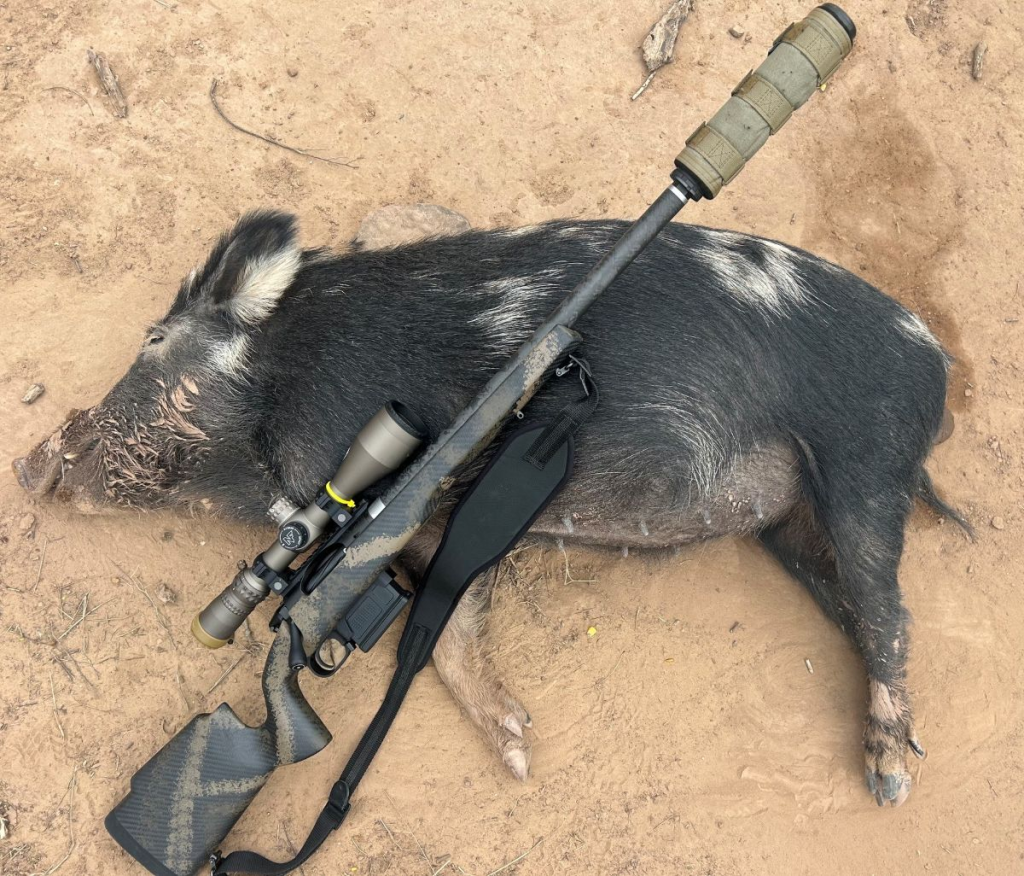
This year, when I opened the safe, a couple of rifles had earned their spot in the lineup just by default, because honestly, they’re always going to be there. The first is my .223. It’s always in the lineup, and it got hauled around for about half of my hunts last year. I killed a couple of pigs and a turkey with it last year (yes, in Texas we can shoot turkeys legally with a rifle). It has a permanent spot. I love the rifle, and it’s been set up to shoot the Sierra 77-grain Tipped MatchKing bullet, which is an absolute monster of a bullet, even out of such a diminutive cartridge.
The other was the 25 Creedmoor, which I hunted with quite a bit last year as well. I’ve been a 6.5 Creedmoor fan for quite a while, but the 25 has just gotten under my skin a bit. The more I play with it, the more I enjoy it. I had loaded a bunch of 110-grain Sierra Tipped GameKings for it, and the ammo is there, and the rifle is already ready to go, so this rifle just outright earned its spot.
There’s another rifle coming along for the ride this year that’s not even officially mine. Notice I said officially! It actually belongs to my good friend DP, who had me mount the rifle and load some ammo for it. It’s a 6 GT, but purpose-built as a hunting rifle, not a target gun. As much as I shoot competitions, there’s just something glorious about a hunting rifle chambered in a traditional comp cartridge that really drives my imagination. I mean, I shoot those cartridges all year long, and you start to have a natural feel for the system’s ballistics, and wind calls just feel effortless, so it really gets me a bit fired up!
Sierra also introduced some new heavy-for-caliber Tipped MatchKings in 2026, and I had some 500-count packs of the new 107 TMK sitting there needing some testing. I mean, I’ve already hunted with that family of projectiles quite a bit, and I already know what they do, so I guess calling it testing isn’t really fair. I know what the end result is going to be, but it’s still a new projectile, and I want to vet it too. And there’s just something about having match-bullet ballistic performance that’s simply awesome.
Next, I had a new rifle built in 2026 that was a purpose-built project. I’ve been shooting a Tikka CTR when I competed in NRL Hunter matches, and while I do love that rifle, I had become intrigued by PRS’s new Sportsman Division. The Tikka would absolutely work in that division, and maybe I should have given it a fair shake. But the other side is that I really wanted a purpose-built rifle, so I had Proof put together a Conviction in 6.5 Creedmoor. The allure of this rifle is the thought that I could shoot every rifle competition I might enter with the same exact rig, and I could hunt with it too. Now, how elegant is that idea? Compete with a rifle all year long, and when hunting season rolls around, you just grab the same rig! You want to talk about effortless wind calls! So of course, this rifle is getting picked!
In 2025, Sierra introduced a new family of bullets called the MatchKing-X bullets. They’re built on their traditional MatchKing profiles, but instead of being a bullet with pretty variable performance on game, this family is purpose-designed to be hunting projectiles first and foremost. It gets right back to what I said above about the elegance of one system filling multiple roles. Compete with it all year long, and then just grab the same exact system and head for the woods. Truly an elegant solution.
Another consideration in my rifle inventory was my 6 Creedmoor. In late 2025, I sold my brother-in-law my precision 6 Creedmoor. He’d been eyeing my precision rifles and decided he wanted one of his own, and how could I tell him no? So I somewhat reluctantly parted with that rifle, and of course, shortly thereafter Sierra announced the new heavy-for-caliber Tipped MatchKing line extensions, including a 116-grain offering that just screams to be used in a 6 Creedmoor. Well, I just couldn’t stand it and built another one in my garage. I took my main trusty 6.5 Creedmoor, which has been the backbone of my hunting battery for the last 6-8 years, and used it as the donor action. Proof Research had just released their MTR stock as an aftermarket stock, and I had a 6 Creedmoor prefit barrel already in my possession. The old rifle already had a TriggerTech trigger, so I just needed bottom metal to complete the ensemble. I assembled the rifle and bedded the recoil lug, and now I had the perfect test bed for that new 116-grain TMK.
The bullet tested amazingly well. I shot it out to 1,000 yards, spent some time shooting groups at 800, and was pretty damn impressed. I have 100 rounds loaded and ready to go for this rifle, and the ballistic profiles are built. I mean, it’s a turnkey, ready-to-roll system, but I’m already ready to change it up.
There’s something that’s been an itch at the back of my mind for a while. I’ve loaded and shot Barnes bullets for years, but I haven’t really killed much with them. I’ve been on hunts where I watched them get used, but I haven’t been the one pulling the trigger. I really need to change that. I want some front-and-center experience where I can see for myself exactly how they work, and this 6 Creedmoor just seemed to be the perfect test subject, especially when I have a couple hundred 95-grain LRX bullets just sitting there waiting to be used. Well, naturally, it just earned a spot in the battery so I could test this new-to-me bullet.
Next, I had a pair of smaller cartridge guns sitting in there as well, and I’ve been using both over the last couple of seasons somewhat interchangeably. One is a 6 ARC, and the other is a 6.5 Grendel. I really have a fascination with both cartridges, and I love the reduced recoil. I’m a big fan of being able to spot my shots, and as the recoil reduces, especially in hunting rifles, less recoil really does make that job much simpler. The thing is, when I looked at both rifles, the 6 ARC started to feel a bit redundant. I’ve got a 6 Creedmoor that made the cut, along with that new 6 GT. Yeah, the ARC has less recoil than both of the others, but still, it’s pretty dang close, especially to the GT. That started pointing me towards the Grendel.
I also have some 130-grain Tipped MatchKings I bought several years ago to try in the Grendel, and I’ve never gotten around to loading them. I see that projectile as the perfect match for the diminutive little cartridge. It also creates the fun and tension of building the setup backward. Remember my comment above where I have one shot on one of my deer leases where a 400-yard shot is a possibility? Well, that immediately jumps to mind when looking at the Grendel, because the short barrel and small case just don’t lend themselves to fast muzzle velocities. The very first thing I had to do was dig into what kind of speed I could generate with the 130s and whether they could maintain the impact velocity I want at the 400-yard mark. This rifle is really on the fence for me. It may make the cut, but it also may not. If I can’t hit 2375–2400 fps for muzzle velocity, I’ll dip well below 1800 fps at 400 yards, which is my minimum impact velocity for making that projectile work the way I want it to.
Finally, I’ve got a rifle I bought a couple of years ago sitting in the safe that I haven’t done much with. It’s a Tikka Roughtech 6.5 Creedmoor. My friend DP really hates Tikkas, which I don’t really understand, but when he took it in on trade, he called me because he knows how much I like them, and he made me a deal I couldn’t really refuse. It had the tan-web stock, which I didn’t mind, but I also don’t love. I’ve always kind of lusted after an Ember, and so I started trolling the interwebs looking for an Ember stock and managed to find one. After getting the new stock on the rifle, I sighted it in and have maybe shot it twice. I’m not sure I even got beyond the actual sighting-in of the rifle. Looking in the safe, I thought it probably deserves a shot at its day in the sun as well.
You know, this is almost an old-school system for me. Tikka rifles are super accurate, and I do love them. Hell, I probably own six or eight of them right now, but I don’t shoot them much other than the NRL rifle I mentioned earlier. I also have a second focal plane MOA scope on this rig, which isn’t my preferred setup, but it’s already assembled and ready to roll. To me, that just begs for a little retro-John-era setup. For that reason, I figured I should load some 140-grain Nosler Ballistic Tips for it. It’s a bullet that I’ve had a long love affair with, because they’ve always been so damn effective. It just kind of feels like coming home.
Making Them Earn Their Spot
So now I’ve selected this year’s rifles, and over the last couple of days I’ve loaded all the ammo. I’m just waiting for a range day to get everything zeroed and then shoot them at distance. Again, this is the fun of the preparation. I look forward to the process, and getting them to the range and developing them into trusted systems is a big part of that fun. It’s also the part of my process that lets me know whether all the systems get to maintain their place in my 2026 battery.
The range step, as mentioned above, is about first and foremost getting super solid zeroes, but also making sure the loads I selected are going to shoot. If you’ve read any of my reloading articles, you know I’ve got an incredibly basic load development system. I pick a powder charge that should work, based on a lot of personal experience and a liberal amount of internet research to see which powder-bullet combinations have worked for other people. It’s like H4350 in the Creedmoors; you just know it’s going to work. I seat the selected bullet so that the bottom of the bearing surface, or where the boattail begins, is at the neck-shoulder junction. That really completes my load development sequence, and it works pretty much every time, but the range visit and zeroing become the validation point.
After I have solid zero checks and also know I’m happy with the accuracy of each system, I transition to shooting them all at distance. I’ve taken velocities with each cartridge as I’m zeroing them, so I build a ballistic profile in either my Kestrel or Applied Ballistics Quantum app. A lot of the time, I use AB Quantum because I like how I can be on a hunt and save my rifle card ballistic chart to my phone’s photo album and set it as my background screen. Then, if I need to take a long shot, I don’t even have to open an app. If I tap the screen, I can see the yardages and my dialing solution without digging into an app, which makes the whole process of getting ready to shoot super fast.
For the rifles to maintain their spot in the morning lineup, they’ve got to be reasonably accurate for 10-shot groups. Then they have to exhibit good groups at 600 yards, where I shoot them for a second accuracy test. If they make it through both tests, and I have enough velocity for the bullets to upset at the longest distances I might use them, they’ve passed the final hurdle for each system.
I’ve written an article about how I choose a hunting cartridge, and you can see it here. This is where I dig fairly deep into how I use muzzle velocity as the metric to determine whether a bullet should work with my system.
So this kind of encapsulates the whole process of how I decide which rifles I’m going to hunt with each year. You also have to understand I’m a tinkerer, and it’s the love of that process that makes this whole project such an anticipated part of every hunting season. It’s the love of playing with my kids, but it’s also fun to run them through their paces and make them earn their spot. They have to accomplish their job too; otherwise, they don’t get included. I want to have faith in each system so that when I open the safe door the morning of a hunt, I can say with confidence, “Okay, which one of you wants to come with me?”
Related Reading
- Match Bullets vs. Hunting Bullets: Why My Thinking Has Changed — How decades of hunting experience changed my thinking about bullet selection and performance.
- Precision Rifle Reloading: What Actually Matters? — My approach to simplifying load development and eliminating unnecessary procedures.
- First Focal Plane vs. Second Focal Plane — Understanding the differences between these two riflescope designs and why they matter.