
How Reticle Location Changes the Way a Riflescope Works
First focal plane vs. second focal plane is one of the most common comparisons shooters make when choosing a riflescope. Both systems are often presented as though one design is universally better than the other. In reality, each system makes different compromises, and understanding those compromises is the key to choosing the right optic for the job at hand.
One of the most common questions people ask when choosing a riflescope is whether they should buy a first focal plane or second focal plane optic. Like many equipment questions, it is tempting to look for a simple answer. First focal plane is better for this. Second focal plane is better for that. Buy one and avoid the other.
I don’t think that is a particularly useful way to approach the subject. Both systems work. Both have advantages. Both also involve compromises. Before deciding which one makes more sense for a particular rifle or application, we first need to understand what is physically happening inside the scope.
Once you understand where the reticle sits and how the magnification system works around it, most of the differences between first and second focal plane optics become pretty easy to understand.
First, a Little Terminology
A first focal plane scope may also be called a front focal plane scope. Those terms mean the same thing. Likewise, a second focal plane scope may also be called a rear focal plane scope. Again, those terms mean the same thing. The names describe where the reticle is located within the optical system. Before we can make sense of that, we need to look briefly at the basic anatomy of a riflescope.
The Basic Anatomy of a Riflescope
At the front of the scope is the objective lens. Light enters through that lens and travels through the main scope body. Near the middle of the scope is the saddle. This is the area containing the elevation and windage adjustments. On many scopes, the parallax or side-focus adjustment is also located in this area. At the rear of the scope is the ocular lens, which is the lens the shooter looks through. On a variable-power scope, the magnification or power-selector ring sits near the rear of the scope, just ahead of the ocular assembly.
Inside the main tube is another assembly containing the lenses responsible for changing magnification. This is generally referred to as the erector assembly. As the power-selector ring is turned, components within that assembly move the magnification lenses in relation to one another. That movement changes how large the target appears to the shooter.
The exact internal construction can vary among manufacturers, but the important point for this discussion is fairly simple: A variable-power scope contains an internal magnification system, and the reticle can be placed either in front of that system or behind it. That decision determines whether the scope is first focal plane or second focal plane.
What Is a First Focal Plane Scope?
In a first—or front—focal plane scope, the reticle is located near the first image plane and in front of the magnification lenses within the erector system. Because the target image and the reticle are both being magnified together, their relationship never changes.
Suppose we turn the power selector from 4× to 10×. The target appears larger. The reticle also appears larger by the same proportion. Go from 10× to 20×, and the same thing happens again. Both the target and reticle grow together.
The shooter may see the reticle becoming thicker and larger as magnification increases, but its relationship to the target remains constant.
That last point is the defining characteristic of a first focal plane optic:
The target and reticle are magnified together, so the relationship between them never changes.
To understand why that matters, we need to talk about subtensions.
What Is a Reticle Subtension?
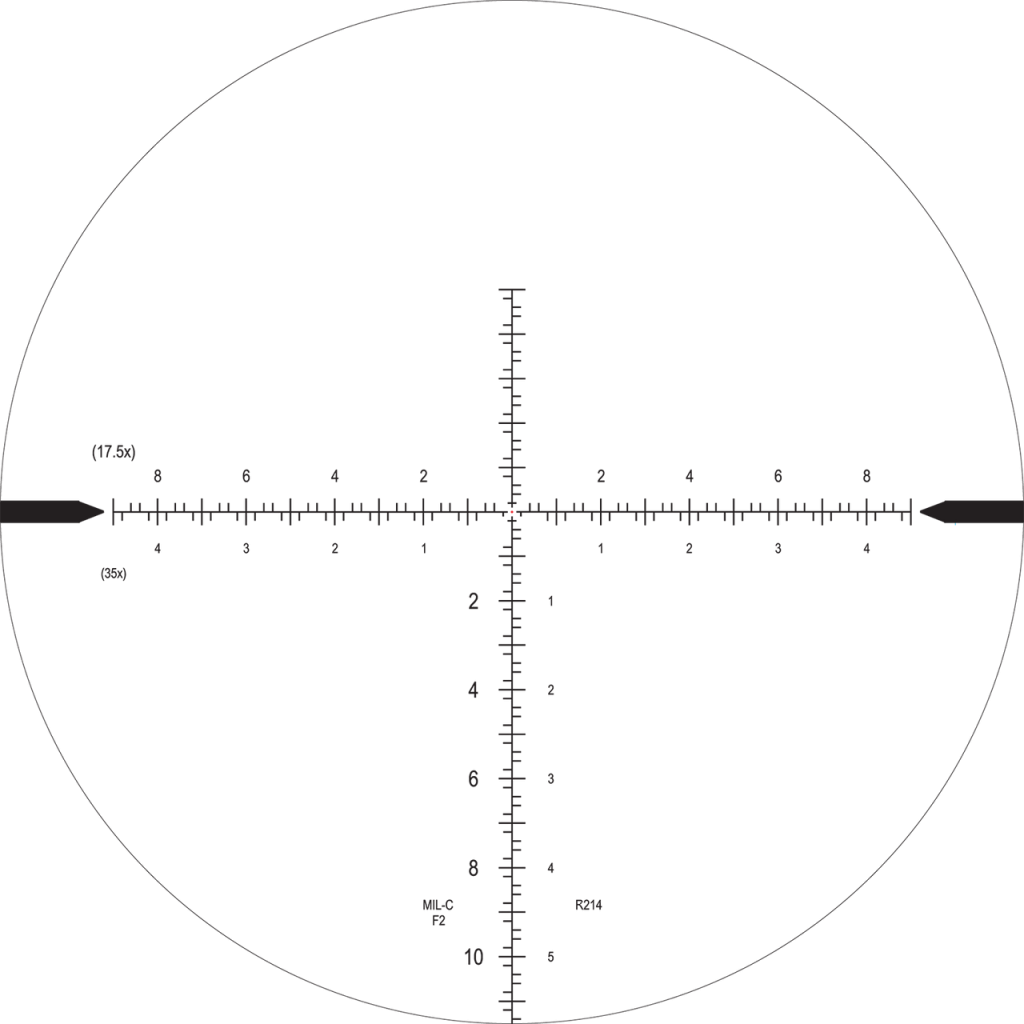
Many modern reticles contain a series of measured marks along the vertical and horizontal stadia lines. Those marks may be used for wind holds, measuring targets, measuring corrections after a shot, occasional elevation holds, and a variety of other tasks. The measured spacing between those marks is called a subtension.
The measurements are commonly expressed in either minutes of angle or milliradians (mils for short). We don’t need to turn this article into a discussion of MOA versus MIL. For now, it is enough to understand that the manufacturer has assigned a known angular value to the space between the reticle marks.
For example, imagine a MIL-based reticle with marks spaced two-tenths of a mil apart.
In a first focal plane optic, those marks remain two-tenths of a mil apart at every magnification. At 4×, they represent two-tenths. At 8×, they represent two-tenths. At 16×, they still represent two-tenths. And finally, at 32×, they’re still two-tenths. Nothing has changed.
Because the target and reticle are always magnified together, the subtensions remain correct regardless of the power setting. That is one of the greatest strengths of the first focal plane system. The shooter does not have to check the power-selector ring before using the reticle. If a correction requires a one-mil wind hold, one mil is one mil at any magnification. The reticle simply works the way it was designed to work.
What Is a Second Focal Plane Scope?
In a second—or rear—focal plane scope, the reticle is located behind the magnification system. As the shooter turns the power-selector ring, the target image becomes larger or smaller. The apparent size of the reticle does not change. In other words:
The reticle stays the same size. The target changes behind it.
This gives a second focal plane optic a very familiar appearance. The crosshair or reticle has the same thickness at low power as it does at high power. That can be extremely useful. But it also means the relationship between the target and the reticle changes as magnification changes.
Because of that, the reticle subtensions cannot represent the same angular measurement at every power setting. A manufacturer must specify the magnification at which those subtensions are calibrated correctly. On many second focal plane scopes, that will be the highest magnification setting, although the owner should always verify the calibration specified for the individual scope.
This means that if the reticle subtensions in a 4-20× second focal plane scope are calibrated at maximum power, 20× is the only setting where they carry their stated values. If the manufacturer says each spacing represents 1 MOA, that is only true at 20×. As magnification decreases, the angular value represented by each spacing increases.
At 20×, each mark represents 1 MOA. Reduce the magnification to 10×, and the target appears half as large relative to the unchanged reticle. Because the magnification has been cut in half, the value represented by each reticle spacing doubles. Each mark now represents 2 MOA. Reduce the magnification again from 10× to 5×, and the value doubles again. Each mark now represents 4 MOA. That is the basic rule of halving and doubling:
Halve the magnification. Double the subtension value.
So, in this example:
- At 20×, each mark represents 1 MOA.
- At 10×, each mark represents 2 MOA.
- At 5×, each mark represents 4 MOA.
The reticle can still be used accurately at those lower settings, but the shooter must understand how its subtension values have changed. That is not necessarily a defect. It is simply a consequence of placing the reticle behind the magnification system.
How These Differences Matter in the Real World
Now we can begin comparing the two systems.
The greatest advantage of a first focal plane scope is that its subtensions remain correct at every magnification. That allows the reticle to function as a reliable measuring tool no matter where the power selector ring happens to be set.
Most experienced long-range hunters and competitors dial their elevation whenever time permits. Once a rifle has been properly trued, the elevation solution should already be correct. If a shot impacts noticeably high or low, that often points to another problem in the shooting system rather than simply needing more elevation. Wind, however, is constantly changing. That’s where the reticle earns its keep.
The most obvious use is holding for wind. Because the reticle remains accurate at every magnification, a three-tenths or five-tenths wind hold is exactly that regardless of where the magnification ring is set.
The reticle also becomes an excellent measuring tool. If a bullet misses because of wind, the shooter can immediately measure the distance from the impact to the intended point of impact, determine the exact correction, and send a corrected shot without ever taking his eye out of the optic.
That same measuring capability is valuable before the shot is ever fired. In precision rifle competition, shooters frequently measure the target itself to understand how much room they have for error in their wind call. If a target measures six-tenths of a mil wide, and the predicted wind holds range from three-tenths to five-tenths, the shooter immediately knows that any call within that bracket will still result in a hit. Instead of simply estimating the wind, they’re managing acceptable error before they ever press the trigger.
That ability to measure consistently—whether holding for wind, correcting a miss, or evaluating the amount of target available for a given wind bracket—is the primary strength of the first focal plane system.
But it comes with a compromise
The First Focal Plane Compromise
Because the reticle and target are magnified together, the reticle becomes smaller as magnification is reduced. At the lowest power settings, a detailed first focal plane reticle can become extremely fine. Some of the smaller subtension marks may become difficult—or practically impossible—to resolve. That may not matter when the shooter is using high magnification on a target several hundred yards away. It can matter a great deal when hunting in dark timber, making a close shot at minimum power or trying to find the reticle against an animal in poor light.
A first focal plane reticle must be designed around an enormous range of apparent sizes. It has to remain fine enough at maximum power that it does not cover too much of the target, yet visible enough at minimum power that the shooter can still find and use it. That is not an easy balance.
Illumination, heavier outer posts, and thoughtful reticle design can help, but they do not eliminate the underlying compromise. The feature that makes a first focal plane reticle so useful at different magnifications—its changing apparent size—can also make it less visible at the low end.
The Second Focal Plane Advantage
A second focal plane reticle does not appear to become smaller when magnification is reduced. Its apparent size remains the same.
For many hunting applications, that is a significant advantage. At low magnification, the center crosshair and heavier reticle elements remain visible. In low light, against dark animals or in cluttered backgrounds, that consistent reticle size can make the sight picture easier to acquire. The shooter does not have to turn the magnification up simply to make the reticle usable.
A simple second focal plane duplex reticle can remain bold, fast and easy to see throughout the scope’s entire magnification range. That is a real strength—not an outdated compromise that should automatically be dismissed. But the consistent reticle size creates the opposite problem. As magnification changes, the subtension values change with it.
The Second Focal Plane Compromise
If the shooter wants to use the reticle exactly as the manufacturer calibrated it, the scope must be placed at the specified magnification. Often, that means maximum power.
Alternatively, the shooter can use another known magnification and calculate the changed reticle values through halving and doubling. Both methods work. But both require the shooter to know where the power-selector ring is positioned.
Imagine seeing a wind change shortly before a shot. With a second focal plane scope, the shooter cannot simply glance at the reticle and assume every mark has its original value. He must know the current magnification and what each mark represents at that setting.
If the scope is calibrated at 1 MOA per mark on 20×, those marks do not still equal 1 MOA at 10×.
They now equal 2 MOA.
At 5×, they equal 4 MOA.
That is manageable when the shooter understands the system and uses it deliberately. It can become a problem when someone assumes the reticle works identically at every power. Once again, this is not a matter of one design working and the other failing. The stress of taking a shot at an animal can also create a roadblock to thinking through where your power selector ring is, and what your current subtensions are based on that setting.
Each design preserves something different. The first focal plane system preserves the angular relationship between the reticle and target. The second focal plane system preserves the reticle’s apparent size. You cannot preserve both at the same time with these traditional designs. That is the engineering tradeoff.
Reticle Visibility Versus Reticle Consistency
The comparison can be reduced to two primary strengths.
A first focal plane scope gives the shooter consistent subtensions. A second focal plane scope gives the shooter consistent reticle visibility. That does not mean every first focal plane reticle is hard to see or that every second focal plane scope is easy to use. Reticle design, illumination, magnification range, and the intended application all matter.
A well-designed first focal plane hunting reticle may remain perfectly useful at low power. A poorly designed second focal plane reticle may still be too fine for low-light hunting. The focal plane is only one part of the entire system. But understanding that one part gives us a much better foundation for evaluating the rest.
Where First Focal Plane Tends to Shine
First focal plane optics make a great deal of sense when the shooter regularly uses measured reticle holds and frequently changes magnification.
That can include:
- precision-rifle competition;
- long-range target shooting;
- field shooting where wind holds are common;
- spotting corrections through the riflescope;
- situations where shots may occur quickly at unpredictable magnification settings.
Competition does introduce one additional use case. In sports such as PRS, stages often involve multiple targets at different distances under very tight time limits. There simply may not be enough time to dial every distance. In those situations, competitors will often dial one distance and use the reticle to hold for the remaining targets. The advantage isn’t that holding is inherently more precise. It’s that it’s faster, allowing the shooter to complete the stage before time expires.
The value is not simply that the reticle appears to grow. The value is that its measurements remain valid. The shooter does not need to memorize which power makes the reticle work. It works throughout the magnification range.
Where Second Focal Plane Tends to Shine
Second focal plane optics make a great deal of sense when reticle visibility and simplicity are more important than having valid subtensions at every magnification.
That can include:
- hunting in low light;
- close-range hunting at minimum magnification;
- rifles where most elevation corrections are dialed rather than held;
- scopes with simple duplex-style reticles;
- applications where the shooter normally uses one known magnification when making longer shots.
A hunter may keep the scope at low power while moving, where the bold reticle remains easy to find. If a longer shot develops, he may turn the scope to its calibrated power before using the reticle marks. That is a perfectly workable system. It simply requires a different process.
Which One Is Better?
Neither. Or, perhaps more accurately, neither is better without first defining the application.
If you need to use subtensions seamlessly at changing magnifications, the first focal plane system offers a clear advantage. If you need a reticle that remains bold and visible at low power and in poor light, the second focal plane system may offer a clear advantage.
The question is not:
Which focal plane is best?
The better question is:
Which compromise fits the way I intend to use the scope?
Do I regularly hold for wind? Do I change magnification while engaging targets? Do I need every reticle mark to remain accurate at every power? Or do I primarily hunt at low power, dial my elevation, and place greater value on seeing a bold reticle quickly in fading light?
Once those questions are answered honestly, the decision usually becomes much easier. First and second focal plane scopes are not competing answers to the same problem. They are different optical systems that preserve different relationships. First focal plane preserves the relationship between the reticle and target. Second focal plane preserves the apparent size of the reticle. Both work. Both involve compromises. The first focal plane vs. second focal plane debate isn’t about determining which design is universally better. It’s about understanding the compromises each system makes so you can choose the riflescope that best matches your rifle, your shooting style, and your priorities.