
Why Today’s Cartridges Are Designed Differently
I don’t think I realized the 6.5 Creedmoor case was anything special for quite a long time. My understanding of what we now think of as the modern cartridge system came in layers and degrees. Part of that came as the amount of shooting I did increased, but I’ve also always been insatiably curious, and that’s had me digging deeper on almost any question. When you notice a cartridge is exceptionally accurate every time you shoot it, in every platform, and then read about the same phenomenon from lots of other people, you start wanting to dig a little deeper into the why.
Then add in the way the industry was changing. More and more cartridges were being introduced, taking advantage of the same basic case geometry and specifications. Well, why were other cartridges kind of copying the new kid on the block? It’s like peeling an onion, and every layer starts to show just a little bit more of the why.
As I dug deeper, it started to dawn on me that it’s more about a system than about just a cartridge. It wasn’t just a new brass case. It went a lot further than that.
What Is a Modern Cartridge System?
Modern cartridge design should really be termed a Modern Cartridge SYSTEM. That’s a much more accurate depiction of where we’re at today. It’s everything taken as a whole, not just a new case. Take the 6.5 Creedmoor as an example: many factors work together as a system. The cartridge itself has very little case taper and a 30-degree shoulder, which help center the case to the bore. The case is shorter and a bit fatter than other cases, so it will fit into a 2.8” box magazine with today’s long, heavy-for-caliber bullets. The rifling twist is specified faster to stabilize those longer bullets, and the freebore is specified to a length that comfortably accommodates them, while maintaining extremely tight clearance so the bullets are ALMOST assured to enter the bore square. That’s the case: magazine, throat, and barrel all working together as a system, not just a cartridge case to make the round go bang.
Why Cartridge Design Changed
To understand modern case design, you have to look at how the industry as a whole has changed. There are a myriad of factors that helped drive us to where we are today, so I’m going to delve a bit into firearms history to help explain this.
Not that long ago, we didn’t have good rangefinders. To range, we usually just guessed, and if you’ve ever tried that much, you’d recognize pretty quickly how badly humans suck at estimating a range. If we didn’t know the range, how do you hit something far away with any consistency at all? For most hunters/shooters, that meant working with point-blank range. This concept revolves around driving a bullet as fast as the cartridge case will allow so the bullet’s trajectory is as flat as possible, reducing range-estimation errors. That system spawned large cartridges that pushed mid-weight bullets at blistering speeds to add a little distance to the PBR.
We also didn’t have ballistic solvers to provide reliable, accurate adjustments, and our ballistic coefficients weren’t always fully accurate. The bullets were good, and so were the barrels on our old rifles, but were they the same as they are today? I remember when I had a rifle that would shoot sub-minute-of-angle; that was something to get truly excited about. Today, if I DON’T shoot sub-minute-of-angle, I think there’s something seriously wrong! That alone is an extreme paradigm shift, and I think that’s because the tolerances our gear is machined to these days are just oh-so-much better.
It really just comes down to the fact that all of our gear has improved quite dramatically. As those improvements gave us laser rangefinders, good ballistic solvers, correct ballistic coefficients, and bullets and barrels with exceptional tolerances, we kinda outgrew our old rifle systems. It’s no wonder the cartridge cases started changing as well.
How Modern Cartridge Design Evolved
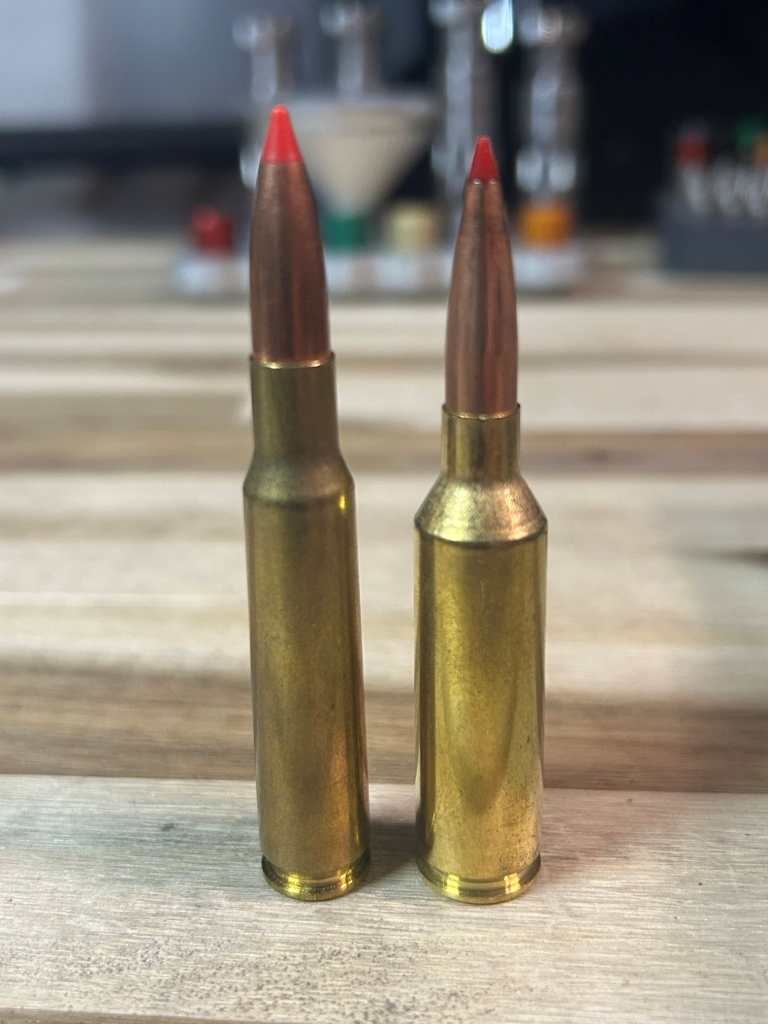
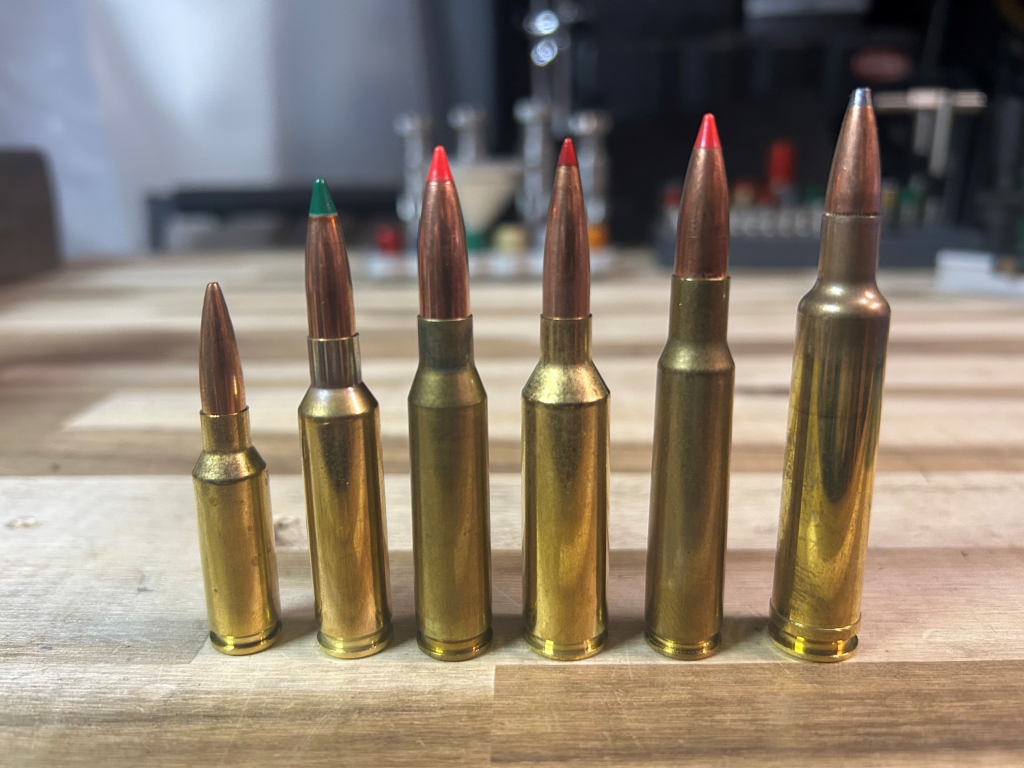
This didn’t all happen overnight either. It’s been slowly and quietly happening for the last 50-60 years. You can trace some of the features on modern cases all the way back to P.O. Ackley’s early designs. I don’t think the primary motivation at the time was understanding how the sharper shoulder angle and very little case taper helped center the cartridge to the bore. It appears to have been more about creating additional room in the case to bump overall velocities. Regardless, it was one of the first moves toward what we now see as a pretty standard set of features on modern cases. And one of the side benefits of that design is that it helps align the cartridge with the bore by reducing how much the case can tilt in the chamber, which contributes to what’s called Principle Axis Tilt. When there’s little taper and a sharp shoulder, the case has very little room in the chamber to tilt, helping it stay centered to the bore line.
The 6 PPC is our next logical jump towards what we see in modern cartridges. The PPC has a short, fat case and was one of those instances where it seemed almost magically accurate right from the start. People began to talk about how the short, fat case led to more efficient powder burn. There may be something to that. Case geometry can influence how a powder charge ignites and burns, although I don’t think we have enough scientific evidence to say how much that contributes to the PPC’s exceptional accuracy. The case followed the same general geometric direction we saw with Ackley’s designs, so it sat wonderfully straight in the chamber, which may be another part of why it was so impressively accurate. Regardless, the short-fat case design is another step along our path.
The next step in this evolution is the .204 Ruger. It combines minimal body taper and a sharp shoulder, using those features primarily to increase powder capacity and velocity. But it also starts moving us closer to a bullet-first approach, and therefore closer to system design rather than simply cartridge design. One of the problems with super-fast varmint centerfires is that their light bullets generally don’t have particularly high BCs, so they shed that impressive muzzle velocity fairly quickly. The idea behind the .204 was different. Its smaller-diameter .20-caliber bullets could achieve surprisingly good ballistic coefficients for their light weight while still being launched extremely fast. That meant they didn’t just start fast; they held onto that velocity surprisingly well downrange. The cartridge was also designed to achieve that performance with considerably less powder, with better barrel life than some of the fast barrel burners that preceded it, like the .220 Swift and .22-250.
Hornady also introduced another concept with this cartridge. It’s one of the first cartridges I can find that uses a very tight freebore diameter. The freebore is only half of one thousandth of an inch larger than nominal bullet diameter. That tight clearance helps control the bullet as it enters the throat and begins its transition into the rifling. This is a design feature we’ll start seeing pop up regularly as we move into newer cartridges.
In 2006/2007, Hornady helped Thompson Center develop a new cartridge for their new bolt-action rifle, the Icon. They wanted a short-action 30 caliber cartridge that would approach the performance of the 30-06. To get there, they started doing something we saw in the 204 Ruger. They approached the case from a systems design perspective, defining what they wanted the system to accomplish. Looking at the lineage of this case, it really does appear that Hornady built it from the ground up. I can’t prove that, but I’ll update this here if I can get some friends at Hornady to substantiate it. Regardless, they had new powder blends available, and with those, they had the idea of making a cartridge that was getting close to 30-06 performance from a short action. They decided on a minimal taper and a 30-degree shoulder, which is becoming a common recurrence. Then, with those new powders, they could drive a 150-grain bullet at close to 3,000 fps.
A couple of things we should note here, though, are that while this case/cartridge begins to approach what we’re calling modern cartridge/system design, it’s not yet fully fledged. Hornady developed this cartridge with the idea of a shorter, squat case with little taper and sharp shoulders, built around a 150-grain projectile. It also carried forward the tight throat geometry we saw in the .204 Ruger, with a freebore diameter only half of one thousandth larger than nominal bullet diameter. But it still hasn’t included some of the things to come, like long, high-BC projectiles and faster twist rates designed around those bullets. It’s another step along that path.
I’m going to add an aside here. It’s notable, but I don’t think it’s super applicable to what we’re tracing. There were other cartridges developing along similar lines during this period, particularly in European and specialized competition markets, but I’m trying to stay focused on the cartridges that had a meaningful influence on the American commercial market.
Why the 6.5 Creedmoor Changed Cartridge Design
So we finally come to the cartridge that coalesces into the first real case/system design, bringing together all these features and a few more into a complete design platform. The 6.5 Creedmoor brings those earlier design features together to create a true systems approach to cartridge design. It was designed around a particular bullet, the 140-grain A-MAX, and the job that bullet needed to accomplish, then worked backward. Ok, we know we need a cartridge that can shoot a long, 140-grain 6.5mm bullet, so what twist rate does that projectile need? We know we need accuracy since this will be used primarily in competition settings, so very tight freebore/throat geometry makes sense. We now know that there’s a phenomenon called Principle Axis Tilt, which a case with little taper and a sharp shoulder helps alleviate, aided by the throat/freebore geometry we’ve already decided on. Now the case needs to be short enough to fit within a 2.8” magazine while keeping that long bullet from extending unnecessarily deep into the powder space, and it needs enough neck to properly support the bullet. Voilà, the 6.5 Creedmoor comes together to deliver all these features.
The interesting thing that so many people miss as they stomp on the 6.5 Creedmoor as Hornady’s golden child, created from wizardly marketing, is that it was kind of a flop for a long time before it caught on. It was introduced in 2007, but didn’t really become a mainstream commercial success until around 2014. It was truly aimed at the competition market, so it didn’t really invade the mainstream commercial market until Hornady began expanding its hunting ammunition offerings and Ruger introduced the cartridge in its American series. That’s when the cartridge really started to gain a commercial footing.
As this cartridge gained commercial traction, Hornady began using the same design parameters for additional designs. The next one to come along was really just a family extension, but one brought about by an already wildcatted version out in the wild. John Snow of Outdoor Life had necked the 6.5 Creedmoor down to 6mm to create a feature on wildcatting for his magazine. The concept eventually gained traction, especially in competition circles. As it gained popularity, Hornady decided to legitimize it, and it became the second commercial cartridge to incorporate all these modern system-design features. Funny enough, though, I don’t think those considerations really drove its original design. Snow was trying to create an accurate, moderate-recoiling wildcat capable of shooting well at 1,000 yards. He started with a case that already incorporated the system we’ve been talking about, and when he necked it down to 6mm, those features came along for the ride. It gained grassroots support largely by virtue of that inherent design. I don’t mean to diminish the thought that went into Snow’s design. In fact, I think his choices were exceptionally well suited to what he was trying to accomplish. The distinction is simply that he didn’t need to work backward and design an entirely new cartridge system the way Hornady had with the 6.5 Creedmoor. He started with a system that already worked and adapted it extremely well to a different purpose.
Modern Cartridges Are Designed as Complete Systems
What happens from here is almost more important than which cartridge came next. The design parameters we’ve been tracing are starting to become almost standardized. Cartridges like the 6 Creedmoor, 6.5 PRC, .300 PRC, .224 Valkyrie, 6 ARC, 7 PRC, and others incorporate many of the same ideas: minimal body taper, sharper shoulders, tight throat/freebore geometry, faster twist rates, and cases designed around the long, high-BC bullets they’re intended to shoot. The exact combination changes depending on what the cartridge is supposed to accomplish, but the underlying design philosophy remains remarkably consistent.
And maybe that’s the real point. Modern cartridge design isn’t about a 30-degree shoulder, a short-fat case, or any other individual feature. It’s about defining what you want the cartridge to accomplish, then designing the cartridge, bullet, chamber, throat, twist rate, magazine, and rifle to do that job as a complete system. And if you look closely enough, each of these cartridges had a design goal in mind; they weren’t just the work of a marketing machine that’s often vilified in our industry.
Continue Learning → Why I Keep Coming Back to the 6.5 Creedmoor