
Learning the Basics
Learning how to read wind for long-range shooting was probably the most intimidating part of learning to shoot long range. There was no number I could simply put into the rifle and trust. The wind was always changing, and the more I tried to learn about estimating it, the more complicated it seemed to become. Developing wind calls has a lot of nuances, and it’s often presented in a pretty mysterious way. I want to try to make it less mysterious. There’s no question that wind can become incredibly complicated, but you don’t need to understand all of that complexity to begin making useful wind calls.
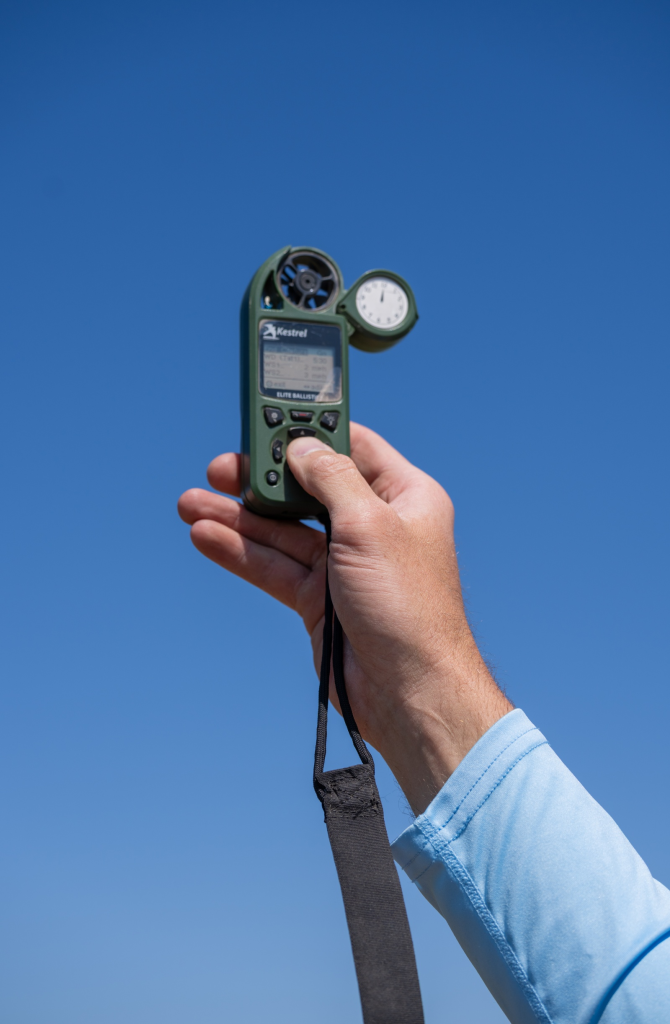
When I started, I had only the foggiest idea of how to create a meaningful wind call. I was taught to use a Kestrel and put a 5-mph and a 10-mph wind in the Wind 1 and Wind 2 columns, respectively, both set at 90 degrees. Then I was supposed to infer from those numbers how to derive a starting wind call. I didn’t really understand. It actually felt like Greek to me, so I generally just pulled some arbitrary wind-call number out of my ass and started there.
At the time, we were shooting in shooter-spotter pairs, and the spotter picked the wind holds. I’d just suggest something like, “Hold .5 left” at 1,000 yards and then watch for what happened when the shooter broke the shot. Once I saw the impact, or more likely the splash of their miss, I’d get a quick measurement, and now I did have a real wind call. Very cowboyish. Just operating by the seat of my pants.
You could still use that method. Check the direction the wind is coming from by feeling it against your face, or better yet, notice the mirage in your optic. Hold for some wind in the direction it’s coming from, send a shot, and let that impact tell you what the wind call should actually be.
Today I use a much more deliberate methodology to build that initial wind call, and I’d like to help you learn how to make the best estimate you can before you send your first shot.
Start by Finding the Wind Direction
To learn to make good wind calls, start by telling me where the wind is coming from. Think of the directions around you like a clock face, and tell me which time the wind is blowing from. It’s also not super important at this stage to get it exactly right. I mean, perfection always helps, but as we learn this process, the difference between 4:00, 4:30, and 5:00 won’t be earth-shatteringly different. Put your face in the direction the wind is coming from, and point at it. Make those little refinements until you’re pretty sure you know the primary direction the wind is coming from.
A lot of times I use both my arms, like the hands on a traditional clock face. With one arm, I point at my target. With the other arm outstretched, I point it towards the primary direction I just determined the wind is coming from. Now tell me: with the target at 12:00, what time is the wind coming from? That’s our first clue in developing a meaningful starting wind solution.
Put the Wind Into Your Ballistic Solver
Once we have a base wind direction, we can use our ballistic solver to start to determine our first wind calls. First, we need to take an azimuth. Big word, but just a term that sounds intimidating for the direction of fire. We need our solver to understand that first. Now we add the direction the wind is coming from into the solver as well, and I find it easiest when I set my solver up to work in the clock face for wind direction, so it’s easy and intuitive to enter. My direction of fire is always noon, or 12:00, and we enter the wind direction relative to that.
Next, we need to pick a wind speed. Notoriously, humans are ridiculously poor at guesstimating wind. Even with some experience, being within 2–3 mph can be a pretty good guess. That’s why a wind meter is a great addition to your kit. In fact, if you’re serious about shooting long range, I think a wind meter is a fundamental piece of kit you should add.
Estimate Wind Speed Without a Wind Meter
Without a meter, there are a couple of ways to make an estimation, but they’re not precise. The first is to really just guess. If the wind isn’t ripping, it’s not uncommon to be able to be within a few miles per hour of the real number, but as the wind speed increases, I think it’s much harder to approximate it closely. Another option is to use a wind app, but you have to use it cautiously. First, wind is pretty dynamic. Second, the weather apps pull that information from a weather station, and those are always a fair way off the ground, so they are measuring clean wind that doesn’t have anything blocking or distorting it, so the figures are almost universally higher than what the wind speed will be closer to the ground. That’s both because of ground friction slowing the wind down and because of hills, trees, buildings, canyons, and other topographical features that inhibit and/or push wind in a different direction. The point is, be cautious when looking at wind speed from an app. The nice part is you will have a good idea of what the broader wind is doing, but in my experience, at the rifle you’re probably going to be several miles per hour slower than that number.
So pick a number, and most solvers allow for two wind speed numbers. Generally, I like my Wind 1 to be a wind speed I think is pretty close to reality, and Wind 2 to be what I think might be the upper wind speed I’m experiencing. This gives me a bracket for my initial wind call.
This is the point where I really want to know how big the target is. If the target is wider than my wind bracket, and my wind choices are anywhere close to accurate, it’s going to be pretty hard to actually miss that target. The choice becomes a little more critical when the target is smaller than the bracket.
When starting to learn to develop a wind call, I’d generally pick wider steel, so you can make sure you’re getting first-round impacts. That will allow you to start seeing success, and in a minute I’m going to explain how to use that information to get a much more precise wind call.
Measure Wind Speed With a Wind Meter
Now, if you do have a wind meter or a Kestrel, this is the point where getting a good starting wind call becomes a lot more precise. Take the wind meter, face it directly into the wind, and capture the wind speed. I’d leave the meter running for 30 seconds to a minute while watching what the wind speeds are. I use a Kestrel, and I’ve noticed over time it will populate a Wind 1 and Wind 2 column for me, but they are often pretty close together when I might have seen a much larger fluctuation of speeds than the final numbers allow. For that reason, I watch the speeds coming through the Kestrel and try to determine what I think represents the prevailing wind, along with the upper end of the wind I’m seeing. I’ll use that prevailing wind for Wind 1 and the higher wind or gust for Wind 2.
If you’re using the Kestrel, your wind speed columns are now populated; if you’re using a wind meter and a ballistic app, use the same concept I explained for the Kestrel to populate your wind columns. You now have an approximate firing solution, so just as above, look at the bracket and measure the target to see what you have to work with.
Make Your First Wind Call
Ok, it’s time to try our first wind hold. Use the Wind 1 solution and send your first round. If you want to hedge your bets, you could also pick a wind call somewhere between Wind 1 and Wind 2 and use the bracketing system. If you’ve chosen a target wide enough, we should be on the plate with this first round.
Once you have a round landing on steel, you can simply use the reticle to measure how far the impact is from the center of the plate. Let me give an example of how I use this measurement. If I have a plate that’s .8 mil wide and I held .4 left for my first shot, I look at where the impact landed on the plate. Let’s imagine that impact is .2 mil left of center. I held .4 left, in the direction of the wind, but the bullet landed .2 left of where I wanted it. That means I actually only needed .2 left for that wind call. I now know that at the moment I squeezed the trigger, and in those conditions, .2 left was the correct wind call. Ideally, send another round immediately using .2 left, and you should be centered on the plate.
Use Each Shot to Refine Your Wind Call
The reason to send another round immediately is that wind is never static. You should have noticed that when you measured it, but even if you’re guesstimating speed, you have to notice the wind blowing, then dying a bit, then gusting, and then coming back to a prevailing speed. It’s very dynamic, so if you wait some period of time to send a follow-up shot, it’s likely to be sent in a different wind condition, and we’re back to revalidating the wind hold.
Where I teach long-range classes, the range has KYL racks, which are a wonderful learning tool for teaching wind holds. KYLs are a series of steel plates that generally start pretty generous in size, and then each progression gets smaller and smaller. As the plates get smaller, you have less room for error, so you have to pay increasingly close attention to what each shot is telling you about your wind call. Yes, there are times when you can shoot an entire sequence without having to change anything about your call, but you can also find times when you’ll quickly be blown off one of the plates if you’re not dynamically adjusting your holds.
This is another good reason not to wait too long between shots. When shooting like this, a great practice is to make a good initial shot, measure your offset, adjust the wind call, and immediately send the next round; then rinse and repeat. When you watch someone with experience run one of these racks, it’s surprising how fast those dynamic changes are being made.
What If Your First Shot Misses?
So what happens, though, if you miss that first shot? Hopefully, if you’re square behind the rifle, you’ll see where the missed shot hit the dirt. You use exactly the same process as measuring a hit on a plate to establish what wind hold you actually needed to be on the plate.
Here’s an example. I’m shooting at the same .8 mil-wide plate, and I’m using a .4 mil hold to the left. This time, the bullet misses off the downwind, or right, side of the plate, but I see the impact in the dirt. Since the plate is .8 mil wide, the right edge is .4 mil from center. Let’s say the bullet landed another .1 mil beyond that edge. That means my bullet landed .5 mil right of center.
I originally held .4 mil left, but the bullet still landed .5 mil right of center. Add that .5 mil correction to my original .4 mil hold, and I now know I needed .9 mil left. Send another round immediately using .9 mil left to validate that call.
Remember That Terrain Changes the Wind
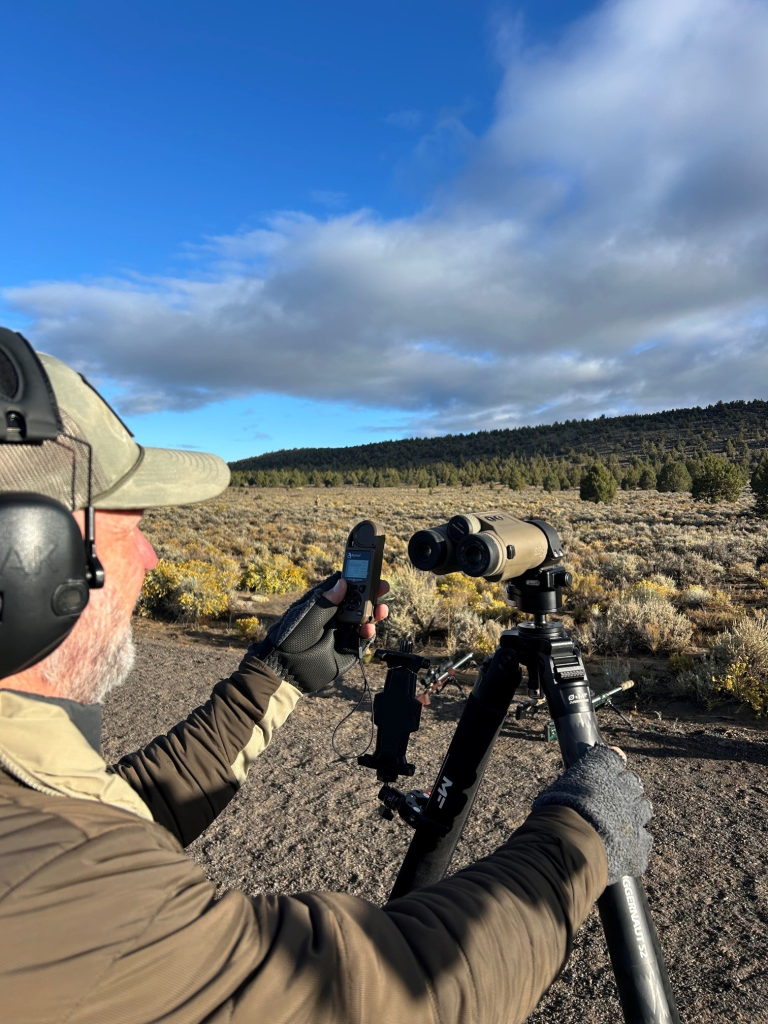
Now I want to introduce one more wind feature to keep in mind. I’ve given the base idea here for wind on a pretty static range, a place where there aren’t a bunch of land features changing what the wind is doing. That’s certainly not always the case. Learn to look at the land features around you and think about how they could change the wind. On many ranges, the wind can be doing one thing close to you and something entirely different farther downrange. Just keep this in mind, especially if you see something weird happen with your call.
Learning to Make Better Wind Calls
Finally, I do want to reiterate that if you’re interested in pursuing long-range shooting, a Kestrel or other wind meter is one of the tools that will pay for itself pretty quickly. I think I’d be lost without a way to get a real wind measurement.
Spend some time practicing your wind calls. It’s one of those rabbit holes where you never quite quit learning. As you get more comfortable with the basics, I go deeper into building a wind call you can trust here. I’m still refining my techniques, and I learn more every time I shoot.