
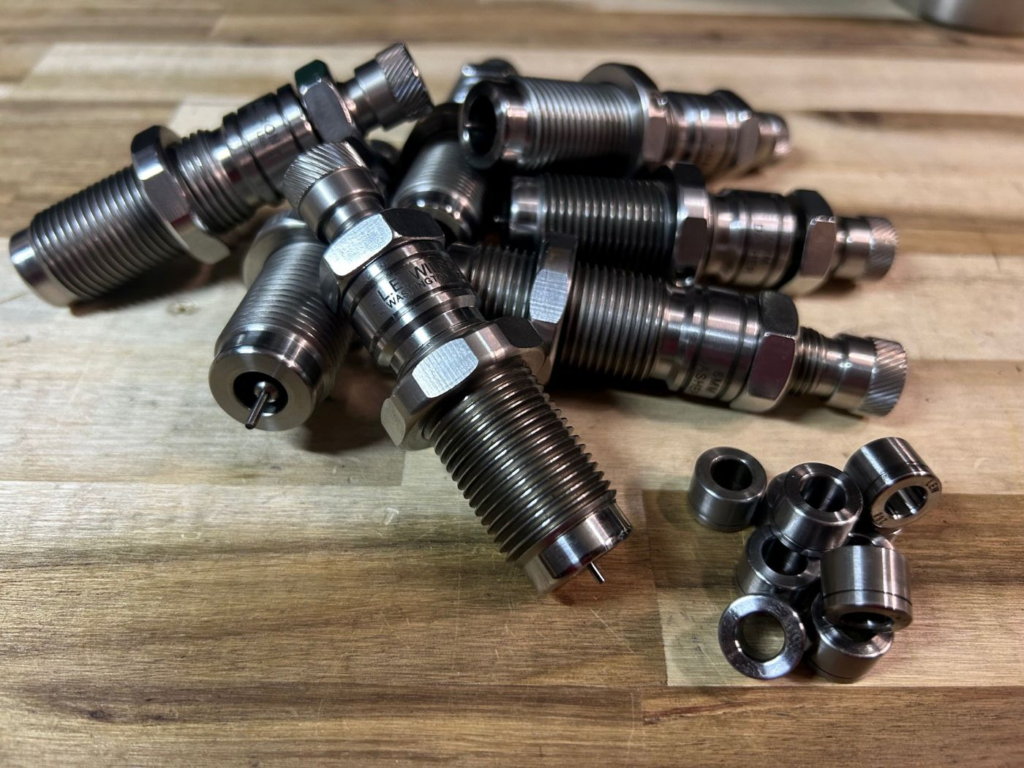
If there’s one category of equipment where I strongly encourage people to buy the best they can comfortably afford, it’s dies.
I spent years chasing concentricity, or how straight the bullet sits relative to the cartridge case. Along the way, I discovered that the design of both sizing and seating dies could make a substantial difference in how easily I produced straight ammunition.
I started with conventional two-die sets. Then I went down a long, dark rabbit hole trying to understand where runout was being introduced into my loading process. It led me through conventional dies, competition dies, Lee Collet dies, body dies, and eventually the equipment I use today.
It’s a long story of discovery, and I’ll explore the mechanics of setting up dies in another article. But I want to explain some of that progression here because my recommendations are intended to help you avoid spending the money I spent learning these lessons.
Sizing Dies: Finding the Source of Runout
When I first started chasing concentricity, I assumed most of my runout was being created during sizing. And I wasn’t entirely wrong. Conventional full-length sizing dies typically reduce the neck diameter considerably, then pull an expander ball back through the neck to establish the final inside diameter. I discovered that pulling the expander ball through the case neck could introduce a surprising amount of runout. So I removed the expander balls.
The resulting cases were considerably straighter, but now I had another problem. Without the expander ball, the necks were sized far too tightly for proper bullet seating. I remembered reading John Barsness’s discussion of repositioning the expander ball higher in the sizing die. By allowing the die to support the case body before the expander contacted the neck, I could push the expander through rather than pull it back through an unsupported neck. The combination of having the case supported, as well as pushing the expander, is what helped reduce the runout. It took some experimentation, including a few crushed cases, but I eventually made it work. My runout improved, although it still wasn’t where I wanted it.
I experimented with competition neck-sizing dies using interchangeable bushings. Unfortunately, I made a mistake in setting them up: I tightened the bushings instead of allowing them to float and center themselves on the case neck. That introduced some runout of its own.
Concurrently, I had read about Lee Collet neck-sizing dies. I bought one, and the results were remarkable. Here was a relatively inexpensive die producing some of the straightest case necks I’d ever measured. My runout was nearly nonexistent.
For a while, the Lee Collet die became my preferred sizing tool. But there was a problem. The Lee Collet die only sizes the neck. After several firings, my cases began chambering too tightly because the shoulders and case bodies needed resizing. So I added a Redding body die.
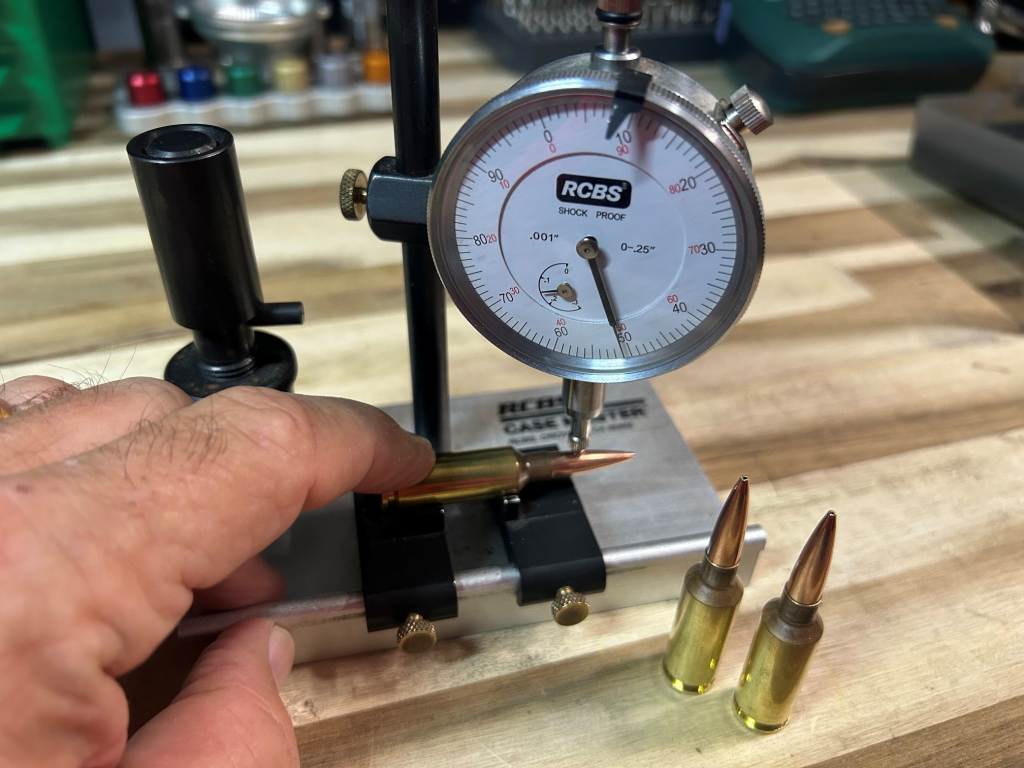
That combination worked exceptionally well. The Lee Collet die produced straight necks, and the Redding body die handled shoulder setback and body sizing.
Eventually, as I began competing more seriously, I was using both dies after every firing. I needed the cartridges to chamber effortlessly, but now I was performing two sizing operations on every case. I wanted to accomplish the same thing in one step. That’s when I moved to L.E. Wilson full-length bushing dies.
Unlike my earlier experiments with bushing dies, I actually read the instructions this time. Wilson specifically directs the user to allow the neck bushing to float so it can center itself during sizing. Imagine that. Following the instructions made the tool work correctly. The results were excellent. I could resize the body, set back the shoulder, and establish my desired neck dimensions in a single operation while producing exceptionally concentric cases. I eventually switched most of my sizing equipment to L.E. Wilson dies. That’s not to say other high-quality full-length bushing dies wouldn’t work just as well.
Today, I also use Short Action Customs sizing dies for selected competition cartridges, primarily my 6 Dasher and 6.5 Creedmoor. The SAC dies produce a small additional improvement in finished-cartridge concentricity. With my Wilson sizing dies, I generally see loaded ammunition ranging from essentially zero to approximately .002 inch of runout. With SAC sizing dies, I’m typically below .001 inch, often between zero and .0005 inch.
Interestingly, I don’t see a meaningful difference when measuring the sized case mouths themselves. The difference becomes apparent after seating the bullets. Does that tiny difference produce smaller groups? I haven’t established that it does. But I enjoy producing ammunition with that level of consistency, and I appreciate equipment that makes it possible.
For other cartridges, including my .25 Creedmoor hunting ammunition, I’m perfectly happy using my Wilson dies. I don’t need the additional complexity and expense of the SAC system for every rifle I own.
Seating Dies: Straight Cases Aren’t the Entire Answer
Once I’d learned to produce straight case necks, I assumed I’d solved most of my concentricity problems. I hadn’t.
I’d heard plenty of people claim that if you produce perfectly straight cases, you’ll automatically produce perfectly straight loaded ammunition. My experience demonstrated otherwise. Bullet seating can introduce runout, too.
One contributing factor is the amount of interference between the bullet and case neck, commonly called neck tension. The Lee Collet dies generally produced approximately .001–.0015 inch of interference in my applications. I noticed that bullets seated more consistently and with less runout with that relatively light interference than they did in necks that gripped the bullets substantially harder. That became another part of my process: I prefer relatively light neck interference rather than unnecessarily squeezing the bullet.
But even with straight cases and carefully controlled neck dimensions, my conventional seating dies could still introduce runout. So I started experimenting.
My first upgrade was to RCBS Competition seating dies with the side window for inserting bullets. Those dies use a sleeve to help align the bullet during seating, but I noticed that the small internal pin retaining the bullet could exert sideways pressure on it. After discussing the issue with an RCBS engineer, I removed the retaining pins and changed how I used the dies. I would raise the case into the die, insert the bullet through the loading window, and allow the bullet-alignment sleeve to guide it toward the case mouth.
My results improved significantly. But I could still occasionally see more runout than I wanted.
Next, I moved to Redding Competition seating dies. The Redding design supports the cartridge case within the die body, much like a chamber, while a floating sleeve helps align the bullet to the case mouth. That improved my results again. But I discovered another problem.
If the bullet was sitting slightly crooked on the case mouth before seating, the alignment sleeve couldn’t always straighten it without introducing some sideways force. This was especially noticeable with boattail bullets. Set one loosely on a case mouth, and you’ll often find that it can sit slightly cocked rather than perfectly centered. If you touch that cocked bullet, you can often feel it binding inside the case neck before you apply any seating force. That in itself could induce runout.
I experimented with all the tricks I’d heard about, including partially seating a bullet, rotating the cartridge, and finishing the seating operation. I measured the results. I couldn’t establish that those techniques made any meaningful improvement. The Redding dies worked very well, but I still had to pay close attention to how the bullet was positioned before seating.
Eventually, I decided to try the inline seating dies I’d seen traditional benchrest shooters using. I purchased a K&M arbor press and my first L.E. Wilson inline seating die. Immediately, my concentricity improved. And then I discovered I’d been using the die incorrectly.
I was setting a bullet on the case mouth, placing the die over the entire assembly, and seating it with the arbor press. Eventually, I realized why Wilson puts a hole in the top of the die. You’re supposed to drop the bullet through it.
The proper sequence is beautifully simple. The cartridge sits in the support ring, the die body slides over the cartridge and supports it like a chamber, and the bullet drops through the top of the die, already aligned with the case mouth. Then the seating stem presses the bullet into place.
There’s another small detail I’ve learned: when moving the assembly beneath the arbor press, I handle the support ring rather than the die body. That minimizes the possibility of shifting the die body relative to the case before seating.
We’re talking about very small differences, often only a few thousandths of an inch. But when I’m trying to produce ammunition with essentially no measurable runout, those details matter to my process.
With that setup, I routinely produce loaded ammunition showing less than .001 inch of runout. And importantly, I do it without having to fight the equipment or repeatedly correct bullet alignment.
What Does All That Mean for Someone Buying Dies?
I’ve told you this story because I don’t want you to assume that purchasing progressively more expensive dies automatically makes better ammunition. One of the biggest improvements I ever saw came from an inexpensive Lee Collet die. Other improvements came from discovering how to use equipment correctly. And some of the smallest improvements came from the most expensive equipment I own.
What I’ve learned is that the design of the dies matters, particularly how they support the case, control neck dimensions, and align the bullet during seating.
For my purposes, a quality full-length bushing sizing die without an expander ball, paired with an inline seating die, provides an exceptionally effective system. It’s the combination I’d encourage a serious precision reloader to consider from the beginning.
But don’t misunderstand me. Good ammunition can be loaded using conventional dies. I’ve done it myself, and I suspect that with everything I’ve learned, I could now return to some of those earlier dies and produce considerably better results than I did years ago. My preference for better dies isn’t based on believing they’re the only way to make accurate ammunition. It’s based on how easily they allow me to produce the ammunition I want.
Good dies don’t necessarily guarantee smaller groups. They can make producing consistently straight ammunition easier, with fewer problems to diagnose and fewer operations required to correct them.
That’s why I’d rather see someone invest in quality dies than purchase an extraordinarily expensive press while compromising on the equipment actually shaping and seating the ammunition.
I also want to add a note on concentricity. Do I think it really matters? In the bigger scheme of things,I don’t think it has a tremendous bearing on how accurately our ammo shoots, especially with modern cartridges and properly matched chambers. What I do think it shows me is the consistency of the process I’ve used to create my ammo. It’s my gut check that each round is loaded close to exactly the same. That part I do think is important.
Related Reading
- Getting Started Reloading: Understanding the Process — A detailed look at the steps involved in producing consistent rifle ammunition, from brass preparation and resizing to bullet seating.
- Choosing Reloading Equipment: Buy Once, Cry Once? — Where I believe investing in quality equipment makes sense, where you can save money, and why expensive tools don’t automatically produce better ammunition.
- Choosing Reloading Components: What Actually Matters? — How brass, primers, powder, and bullets contribute to consistent ammunition without unnecessary experimentation.