
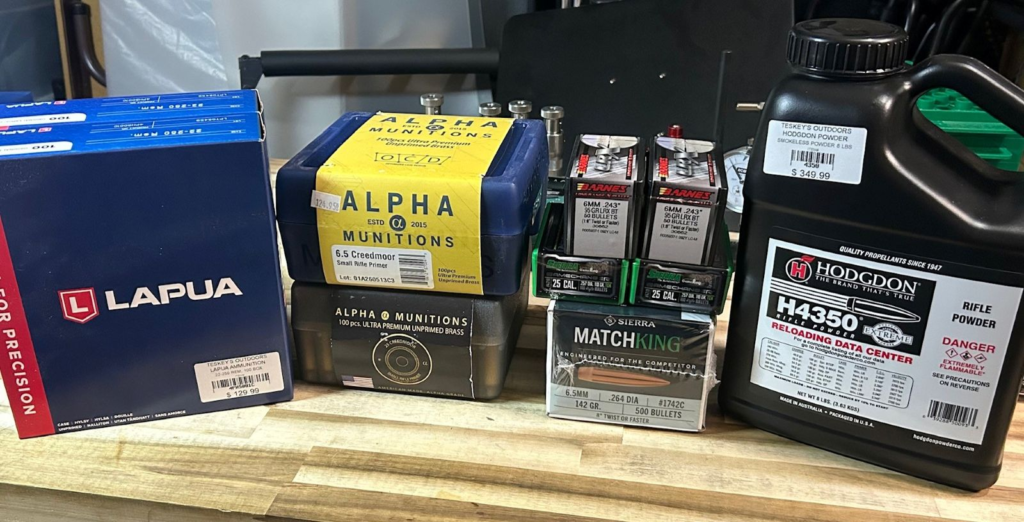
When I first started reloading, I spent a tremendous amount of time trying different combinations of bullets, powders, primers, and brass. Like most reloaders, I was searching for the combination that would produce the smallest groups and the most consistent ammunition.
Over the years, I’ve become considerably less interested in experimenting with endless component combinations. It’s not that components don’t matter. They absolutely do. But I’ve learned that selecting good components from the beginning, understanding what each contributes to the finished cartridge, and developing a consistent loading process generally accomplishes more than constantly searching for something better.
Today, I spend very little time experimenting with components. I generally select what I want to use, assemble the ammunition, and go shoot it. And more often than not, it works exceptionally well.
Brass: Quality and Consistency Matter
I think brass is one of the most important components in producing consistent ammunition, particularly when you’re shooting at extended distances. I’ve loaded ammunition using virtually every major brand of brass over the years. Winchester, Remington, Federal, Hornady, Starline, and others have all produced accurate ammunition for me. I don’t think you need premium brass to produce small groups.
But when I began competing seriously in precision rifle matches, I became increasingly interested in reducing velocity variation. At extended distances, variations in muzzle velocity begin to matter because they affect where the bullet lands vertically. That’s where I began appreciating premium brass.
These days, I primarily use Alpha and Lapua brass for my competition ammunition. I’ve found that good brass makes achieving low extreme spreads and standard deviations considerably easier. Why? My suspicion is that consistent internal case volume is a significant part of the equation.
Brass cases that appear identical on the outside don’t necessarily have identical internal capacities. Differences in wall thickness, case-head construction, and other manufacturing characteristics can affect the volume available for powder and expanding gases. When that volume varies, pressure and velocity can vary as well.
I can’t tell you precisely how much of my improved velocity consistency comes from better brass versus improvements in other parts of my loading process. When I switched to premium brass, I also upgraded to an AutoTrickler V4 powder dispenser. My typical standard deviations dropped from the teens to approximately 6–7 fps, but because I changed both things together, I can’t honestly claim which contributed more.
What I can tell you is that I’ve found it much easier to produce remarkably consistent ammunition using high-quality brass. For a hunter shooting relatively modest distances, that advantage may not justify the additional expense. For someone competing at 1,000 yards and beyond, I think it can.
I’ll also add that for my hunting cartridges I’m often using other brands of brass, and as mentioned above, I don’t think it really detracts from my accuracy or dependability. I have noticed my SDs are a bit higher, but that’s not concerning enough to drive me into buying premium brass for every cartridge I load.
Keep Your Brass Together
There’s another consideration that I think matters just as much as purchasing quality brass: keeping your cases organized. I don’t simply keep brass separated by cartridge. I keep it separated by lot numbers, and I make sure those cases have the same number of firings. Keeping brass from the same manufacturing lot together is extremely important for consistent loads.
On my competition rifles, I even go as far as marking the extractor grooves with different colors so I can identify which batch a fired case belongs to. When I’m shooting a match and recovering brass, those markings help me put the cases back into the correct groups.
Why go to that much trouble? Because I’ve seen differences in velocity between batches of brass, even when the ammunition was assembled using the same basic process. That can become a problem when your ballistic solver is working from a muzzle velocity established with one batch, and you’re shooting another. I’ve even observed velocity differences between batches loaded months apart, despite using the same basic loading process.
For major competitions, I want my ammunition assembled from the same lots of brass, bullets, primers, and powder whenever possible, and also loaded in sessions very close together. I want to eliminate any unnecessary variables before I ever arrive at the match. Even small changes in velocity in a match setting can have unfavorable results.
Primers: Find Something That Works
I think primers are another component that reloaders can spend far too much time experimenting with. There are certainly differences between primers. Their construction, ignition characteristics, and intended applications vary. But I don’t spend much time switching primers in search of slightly smaller groups.
For small rifle primers, I generally use CCI 450s. For large rifle primers, I favor Federal Gold Medal Match GM210Ms, and for large rifle magnum applications, I typically use GM215Ms. Those are primers I’ve used extensively, and I’m comfortable with the results. I have used other primers, though with great success, so don’t take my list as the have-to-have primers. Standard Federal 210s, CCI large rifle primers, and Winchester or Remington primers all work just fine. I just don’t find a need to be constantly switching primers to find the perfect one.
There are exceptions. With certain spherical powders, I’ve sometimes preferred primers with hotter ignition characteristics. Ball powders can be harder to ignite, so a warmer primer can help rifle cartridges with ball powders shoot more consistently.
But the basic principle remains the same. I select an appropriate, high-quality primer for the cartridge and powder I’m using, then concentrate on maintaining consistency rather than trying five different primers to see whether one might produce a slightly smaller group.
I would much rather spend my time shooting.
Powder: Start With a Proven Combination
Powder selection is an area where I think beginners can easily make the process more complicated than necessary. There’s an enormous variety of rifle powders available, and they don’t all behave the same way. Burning characteristics, temperature sensitivity, case fill, and suitability for a particular cartridge all matter.
But that doesn’t mean you need to experiment with a dozen powders to find one that works. My approach is to begin with a powder that has already established an excellent reputation in the cartridge I’m loading.
H4350, for example, has been extraordinarily successful in cartridges such as the 6.5 Creedmoor, 6 Creedmoor, and several other precision rifle applications. It doesn’t take much research to find that this combination in those cartridges usually works extremely well. With that said, N150, Reloder 16, StaBALL Match, and a few other powders have also proven to be consistently good choices.
There are plenty of other excellent powders, and the right choice depends on the particular cartridge and bullet. The point is that I don’t need to reinvent something that’s already well understood. I can look at reliable published loading data, consider what experienced shooters have learned about a particular cartridge, and select a powder with a strong record of performance. Then I can concentrate on producing ammunition consistently.
Temperature Stability Matters
One characteristic I pay particular attention to is temperature stability. Living and competing in Texas, I shoot in conditions that can vary dramatically. Ammunition that performs predictably in cool weather may behave differently when it’s being shot in the summer heat. Temperature changes can affect the burning characteristics of powders, potentially changing velocity and pressure.
That’s why I’ve generally favored powders with well-established temperature-stability characteristics, including many of the Hodgdon Extreme powders. That doesn’t mean every powder marketed as temperature stable will behave identically in every cartridge. But it is a characteristic I consider important, particularly for ammunition that may be used in widely varying conditions.
I’d rather choose a powder that performs predictably than one that produces a little more velocity but changes considerably with temperature.
Maximum Velocity Isn’t the Goal
This is another area where my approach to reloading has changed over the years. I don’t believe in pushing cartridges to the ragged edge of their performance capabilities simply to gain another 50 or 100 feet per second. If I need substantially more velocity than a cartridge can comfortably deliver, I’d rather choose a cartridge with greater capacity.
For example, if I want performance beyond what I can reasonably obtain from a 6.5 Creedmoor, I’d rather use a 6.5 PRC than push the Creedmoor harder. And if I want more performance than that, there is the Weatherby 6.5 RPM. The point is, there’s always the next case size up if you need more speed and performance. There’s little advantage in creating excessive pressure, wearing out brass prematurely, and compromising the consistency of the ammunition simply to chase a velocity number.
I also haven’t found that maximum velocity is a prerequisite for excellent accuracy. Some of my best-shooting ammunition has operated at moderate velocities rather than the highest speeds I could achieve. I want enough velocity to accomplish the intended task, but I also want consistent ammunition, reasonable brass life, and a loading process that doesn’t require constant adjustment. To me, that’s a much better combination than chasing the fastest possible load.
Choosing Bullets: Start With the Intended Purpose
Bullet selection is where I make a clear distinction between competition ammunition and hunting ammunition.
For competition, my priorities are relatively straightforward. I want a bullet that shoots accurately, has a useful ballistic coefficient, and performs consistently in the conditions I’m likely to encounter.
For hunting, terminal performance becomes a much more important consideration, because the bullet has to accomplish something entirely different when it reaches the animal. Those are two different jobs, and they deserve different considerations.
Competition Bullets and Ballistic Coefficient
When I’m selecting a bullet for precision rifle competition, one of the first specifications I look at is its G7 ballistic coefficient. Generally, I’m looking for a G7 BC of approximately .280 or higher. If I can get into the .300s without creating other problems, that’s even more appealing.
Why? Because a higher ballistic coefficient generally reduces the bullet’s susceptibility to wind drift when other relevant conditions are comparable. Wind is one of the biggest challenges in precision rifle competition. Anything that provides a little more margin for error can be valuable.
For example, my 150-grain Sierra MatchKing has trued to a G7 BC of approximately .353 in my competition rifle. When shooting alongside competitors using 6 Dashers with bullets in the .280–.290 G7 range, I’ve often found that my wind corrections are one or two tenths smaller under comparable conditions. That doesn’t eliminate the need to read wind correctly, but it can provide a useful advantage.
Of course, BC isn’t the only consideration. The bullet still needs to perform accurately in the rifle, and the complete system has to be manageable.
Bullet Weight and Recoil
In a heavy PRS rifle, bullet weight generally isn’t a major limitation for me. My competition rifles commonly weigh 22–26 pounds. At those weights, I can use relatively heavy, high-BC bullets without creating enough recoil to seriously interfere with spotting impacts.
But that changes when the rifle gets lighter. I recently built an NRL/PRSuit competition/hunting rifle that I intend to use this season. When I tried 150-grain Sierra MatchKings in that rifle, the recoil made it difficult to see my impacts. I switched to 142-grain MatchKings, and the rifle became much more manageable. I still need to be square behind the rifle and maintain good fundamentals, especially from awkward positions, but I can now spot my impacts much more consistently.
That’s a case where moving to a lighter bullet made sense, even though I was giving up some ballistic coefficient. The goal isn’t simply to shoot the highest-BC bullet available. It’s to select the bullet that works best in the rifle and the conditions where you’ll actually use it.
Don’t Let Reputation Replace Results
There’s another trap I think reloaders fall into when selecting bullets. We tend to listen to what everyone else is shooting. If a particular bullet becomes popular in competition, people begin to assume it’s the only sensible choice. If another bullet develops a reputation for being difficult to tune, people may avoid it without ever trying it themselves. I’ve seen that happen repeatedly.
I’ve had excellent results with Sierra MatchKings or Hornady ELD bullets, including bullet designs that other shooters have described as finicky or prone to unexplained fliers. My experience simply hasn’t matched those complaints. That doesn’t mean those shooters didn’t encounter problems. It means their experiences aren’t necessarily universal.
I’ve learned to listen to knowledgeable shooters, consider what they’ve found, and then evaluate the results in my own rifles. I don’t believe in changing components simply because a different brand or bullet design happens to be popular at the moment. If a bullet is producing the accuracy, velocity consistency, and ballistic performance I need, I see little reason to replace it.
Hunting Bullets Require Different Considerations
When selecting a hunting bullet, the question changes.
Ballistic coefficient still matters, particularly at extended distances, but it isn’t the only consideration. I want a bullet that performs appropriately when it strikes the animal. That means considering the bullet’s construction, its intended impact-velocity range, and how it is likely to behave in the game I’m hunting.
A bullet designed primarily to produce small groups in competition may behave differently from a purpose-built hunting bullet. But I don’t believe it’s useful to make blanket statements that all match bullets are unsuitable for hunting or that every bullet marketed for hunting is automatically superior.
Bullet construction and actual terminal performance matter more than the category printed on the box. That’s a larger discussion, and one I intend to explore separately. For now, the important point is simple: select the bullet around what you expect it to accomplish, not simply the cartridge you’re loading or the bullet’s reputation.
Good Components Don’t Replace a Good Process
I’ve spent decades experimenting with reloading components and equipment. These days, I find myself doing considerably less of it. I buy quality brass, select an appropriate powder, use primers I know perform consistently, and choose bullets based on what I want the rifle to accomplish. Then I assemble the ammunition using a consistent process.
I’ve found that this approach routinely produces exceptionally accurate ammunition without the endless experimentation that seems to consume so much of the reloading community. That doesn’t mean there’s never a reason to change components.
Sometimes a rifle clearly prefers something different. Sometimes a particular component becomes unavailable. Sometimes a new bullet or powder offers a genuine advantage worth investigating. But I no longer assume that every load needs to be endlessly tuned before it can perform well.
Choose quality components that suit the application, understand why you’re using them, and concentrate on producing ammunition consistently. You may discover that you don’t need to spend nearly as much time experimenting as you thought.
Related Reading
- Getting Started Reloading: Understanding the Process — A practical guide to preparing brass, resizing, priming, powder charging, and bullet seating, with an emphasis on understanding why each operation matters.
- Choosing Reloading Equipment: Buy Once, Cry Once? — What decades of reloading taught me about choosing equipment, where to invest, and where expensive tools aren’t necessary.
- Chasing Concentricity: What I Learned About Reloading Dies — How sizing and seating dies influence cartridge alignment, runout, and the consistency of finished ammunition.
- Precision Rifle Reloading: What Actually Matters? — My approach to simplifying load development and eliminating unnecessary experimentation.