
I spend a lot of time perusing internet chat boards. I’m truly a “gun nut,” so it’s one of those kill-time-while-relaxing occupations. The interesting thing is I often see recurring questions pop up on those sites, and rifle twist rate is one of them. I understand where the questions come from, but I think a lot of people treat twist-rate recommendations like hard rules without really understanding what the number means or how much twist they actually need for what they’re trying to do.
What Is Rifle Twist Rate?
First, twist rate is simply how far a bullet travels down the bore while making one full revolution. If you’re shooting a 6.5mm bullet through a 1-in-8 twist barrel, the bullet makes one complete revolution every eight inches. The bigger question is, “Why does that matter?”
The simple reason is the bullet really wants to travel backward. I can give you all the technical words and reasons, but I’d rather keep this in layman’s terms so it becomes intuitive. As the bullet moves through the air, any time it starts to tip away from nose-first, the air pushes on it in a way that tries to turn it around. Spinning the bullet gives it the stability it needs to stay pointed forward.
Why Bullet Length Matters More Than Weight
But there is another wrinkle. The longer the bullet is, the more leverage the air has to try to turn it around. Spinning it faster gives the bullet more stability to resist that additional leverage and keep flying nose-first. That last sentence is of vital importance to our discussion on twist rate. A lot of people think bullet weight determines what twist rate you need, but bullet length is really the metric that matters. It’s all about the air having more leverage to turn the bullet in flight, but spinning our bullet faster can overcome the air’s ability to use that leverage.
Think about a spinning top. As it slows down, it starts to wobble and becomes less stable. Spin it faster, and it settles down and holds itself upright much more cleanly. It’s not a perfect analogy, but it gets us close enough to understand what happens to a bullet. The same basic idea applies to a projectile. The longer the bullet is, the harder the air tries to turn it around, and the faster we spin it, the easier it is for the bullet to keep flying nose-first.
I think this is why bullet weight and length get confused somewhat, is because heavier bullets are generally longer, but shape has a large bearing on this. Think of a round-nose bullet versus a long tapered-nose match bullet. They may weigh the same, but because the round-nose bullet is much shorter, it generally won’t need as much twist to stabilize.
How Much Stability Do You Really Need?
Which brings us to the question that really matters. How much stability do you actually need? How you’re using a bullet actually has a lot of bearing on this subject. There’s a lot of internet chatter that X bullet needs Y twist to work, and it’s like a line in the sand. If you’ve spent any time at all reading anything about twist rates, I’m sure you’ve heard of stability calculators. If you haven’t, I’m going to introduce you to one here.
Before I show you the link to a stability calculator, I want to explain what you’re looking at. It’s a formula Donald Miller developed long ago to estimate how much twist a barrel needs to fully stabilize a bullet and keep it flying comfortably in that nose-forward attitude. When you run a bullet through this calculator, you will get a number called Sg. Sg isn’t really an acronym the way we usually see one; it’s the symbol used for gyroscopic stability. Think of our top analogy again. When it’s spinning smoothly, you’re looking at gyroscopic stability.
A quick note on calculators: For the examples in this article, I’m using the Berger Stability Calculator. I’ve also developed a Rifle Twist Rate Stability Calculator here at Childs Play Outdoors. Both use the Miller stability formula, but the CPO calculator also incorporates the Courtney–Miller correction for polymer-tipped bullets. I encourage you to experiment with both and compare the results.
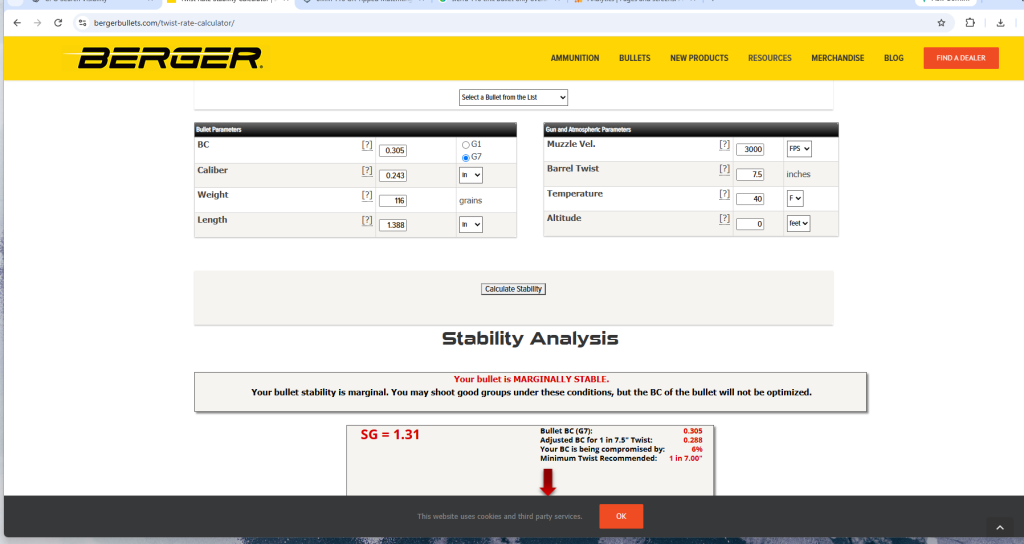
Gyroscopic stability is easy to envision when we go back to my top example. When the top is spinning slowly, have you noticed it can wobble at the top and the bottom, but along its axis there’s not much wobble? That’s a good way to envision the flight attitude of a marginally stable bullet. Spin the top quicker, and you now see that smooth spin, and it’s the same for a bullet.
When we run a bullet through a stability calculator, a number around 1.0 means our top is barely spinning fast enough to stay upright. It may still be wobbling quite a bit, but it hasn’t fallen over. As that number goes up, think of the top spinning faster and becoming smoother and more settled. By the time we get near 1.5, we have a comfortably spinning top with almost no wobble.
The thing is, there’s a lot of gray area between those two numbers. If we just listened to common internet knowledge, we’d believe 1.5 Sg is a hard threshold that every bullet needs to meet. But in reality, bullets with calculated stability factors below 1.5 can shoot extremely well. The problem is, not all of them do. I’ve seen both sides of this firsthand.
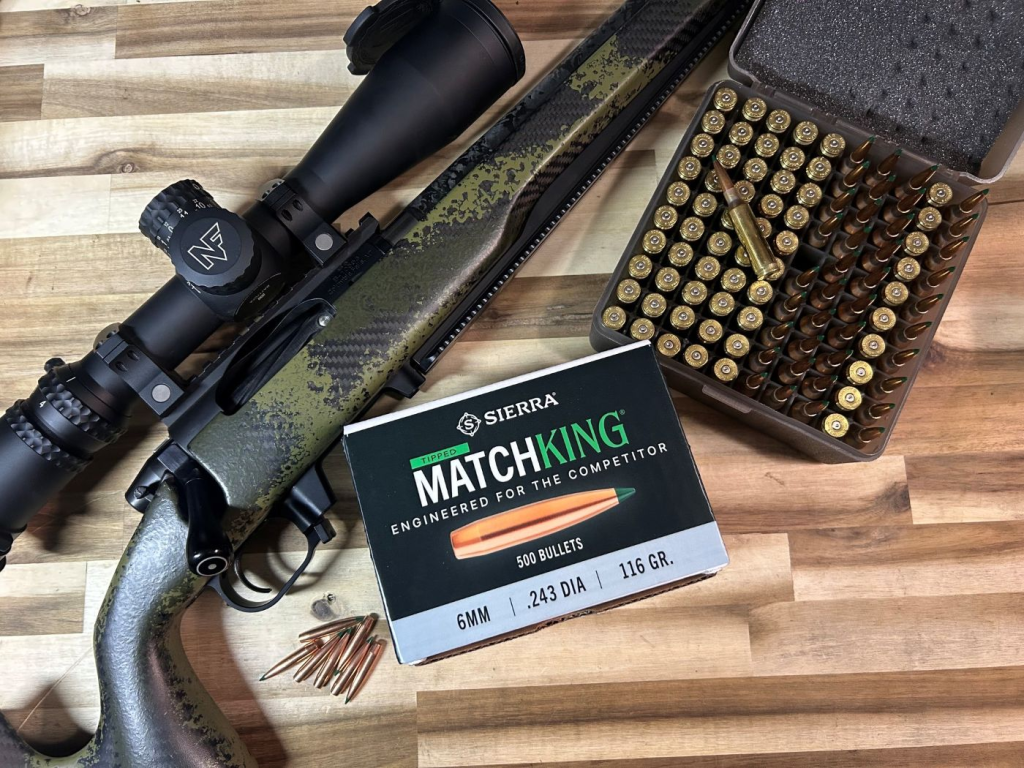
Sierra developed several new heavy-for-caliber Tipped MatchKing bullets in 2026, and I was fortunate enough to receive pre-production samples of their 6mm 116-grain TMK in late 2025. Sierra asked me to test them for accuracy at 100 yards and again at 800 yards to see how well they shot and whether their advertised ballistic coefficient held up. Using the original Miller formula, that bullet calculated at approximately 1.32 Sg in my rifle. At 100 yards, it grouped into a ragged hole, and at 800 yards, it continued to group under a minute of angle. My elevation also tracked Sierra’s supplied .304 G7 BC very closely.
But there’s an important detail here. That bullet has a plastic tip, and the original Miller formula doesn’t properly account for the difference in density between the tip and the metal portion of the bullet. For years, I used a rough shortcut of subtracting half the plastic tip’s length from the overall bullet length. It wasn’t the actual Courtney–Miller correction, but it seemed to get me closer to what I was seeing on target. Using that shortcut, the 116 TMK calculated at approximately 1.44 Sg, considerably higher than the original 1.32.
The Childs Play Outdoors Stability Calculator incorporates the actual Courtney–Miller correction, which accounts for the lightweight tip without simply shortening the entire bullet. That’s important because we need to be comparing realistic stability estimates before drawing conclusions about how much stability a bullet actually needs.
Now let’s look at another example that didn’t turn out nearly as well. Recently, I was working with a friend’s rifle shooting Sierra’s 110-grain 6mm MatchKing. We calculated a stability factor of approximately 1.38. In warmer weather, this bullet had shot quite well, but in 44-degree temperatures, it struggled badly. A ten-shot group scattered across an area about the size of a orange. And this wasn’t an isolated experience. I’ve seen similar behavior with that particular bullet in several rifles over the past few years.
I suspect bullet design may play a role here. The 110 SMK has a long, tapered nose, while the 116 TMK has a different nose profile and a polymer tip. The shape of the bullet affects its aerodynamic characteristics, and the Miller formula doesn’t account for every aspect of bullet design. I can’t say with certainty that the difference in ogive shape explains what I’ve observed, but I think it’s worth considering.
Here’s where my thinking has changed a little. I’ve spent years telling people not to get too concerned about a calculated Sg in the 1.3 to 1.4 range, because I’ve personally seen bullets perform very well there. I still believe those results are real, but I’ve also seen enough examples of bullets struggling in that same range that I’m more cautious about making that recommendation today.
An Sg of 1.5 isn’t a magic number, and falling below it doesn’t automatically mean a bullet won’t shoot. But as we move farther below that number, we’re giving up some of our margin for differences in bullet design, environmental conditions, and the limitations of the stability calculations themselves. That’s why I still believe you need to test the bullet rather than relying entirely on a calculator. But if I’m starting from scratch and choosing a twist rate for a new barrel, I’d much rather have some stability margin than hope a marginal combination works out.
How Environment and Velocity Affect Bullet Stability
We should also discuss environmental factors, because bullet stability can change with environmental conditions, and in some cases that can affect the twist rate you need. For that reason, we need to talk about air density. Don’t get scared off here; I’m going to try to make this as painless as possible.
When we fire a bullet, air resistance and gravity are the two biggest forces acting on it. Gravity obviously doesn’t change, but the air absolutely does. I often describe air as being thicker or thinner because that’s sometimes easier to envision than talking about density. Higher elevation generally means thinner air, while lower elevation means thicker air. Temperature matters too. Colder air is thicker, while warmer air is thinner. Think of it this way: the thicker the air, the harder the bullet has to work to get through it. Barometric pressure and humidity also affect air density. Pressure can have a meaningful effect, while humidity usually has the least influence of the four factors.
I explain that because those are the factors you’re going to be asked about when entering a bullet into a stability calculator. When I’m planning what bullet I want to shoot and what twist rate I’m using, I usually plan for worst-case conditions in the calculator. If you use the coldest air you’ll probably shoot in, along with the lowest elevation you might realistically encounter, you’ll get close to the lowest Sg number you’re likely to see. Then you’ll know whether there’s a point where you may need to consider a faster twist or a shorter bullet.
Another factor that often gets thrown around is that speeding a bullet up dramatically changes its stability. Yes, velocity absolutely affects stability, but not nearly as much as people sometimes make it sound.
Let’s use my 6mm 116 TMK example again. If I shoot that bullet at 2,700 fps in 30-degree temps at sea level, the calculator gives me an Sg of 1.24. I’m not correcting for the plastic tip here because I’m only trying to show how much velocity changes the result. Now increase the velocity all the way to 3,000 fps. The Sg only moves to 1.28. That’s a 300 fps increase for just .04 more Sg. Now leave the velocity at 2,700 fps and change the twist from 1-in-7.5 to 1-in-7. The Sg jumps to 1.42. That’s the important part: speeding the bullet up helps a little, but changing the twist rate is a much bigger lever when it comes to stability.
Before we move on, I want to reinforce one point. Don’t treat a calculated Sg as a guarantee of how a bullet will perform. A bullet with marginal stability might shoot very well, or it might lose ballistic coefficient or struggle with accuracy. The farther you shoot, the more important any BC loss can become, but as we’ve seen, accuracy problems can show up at short distances too. The calculator helps us understand what to expect, but the target tells us whether the combination is actually working.
How to Choose the Right Twist Rate
We’ve spent a lot of time discussing stability and drifted away from twist rates, but the two concepts are closely entwined. The real takeaway is that you need to understand stability so you can choose the twist-rate barrel you need. The easiest way to decide on a twist rate is to start with the bullet you want to shoot and work backward. Sometimes, if you’re buying a factory rifle, those decisions have already been made for you, but at least you know ahead of time whether your desired bullet is a good match for the twist rate you have.
So when you’re choosing a twist rate, start with the longest bullet you realistically might want to shoot and run it through the stability calculator at the worst conditions you expect to use it in. Then look at what twist rate gives that bullet enough stability. Working the problem backward like this gets you straight to the right answer without having to fight your system. I also like to give myself a little margin here. Yes, I’ve talked a lot about bullets working perfectly well below an Sg of 1.5, and I stand by that. But if I’m choosing a barrel from scratch and can easily give myself a little more stability without creating another problem, I usually will. That doesn’t make 1.5 a hard minimum. It just means I’d rather build in some cushion than intentionally design the system right on the edge.
Related Reading
- The Modern Cartridge System — How modern cartridge design, bullet length, and rifling twist rates work together.
- What Is Ballistic Coefficient? A Simple Explanation — Understanding how bullet shape influences aerodynamic performance.