

If you spend much time around precision rifles, custom chambers, or handloading, eventually you are going to hear someone talk about freebore. The word gets used constantly, but a surprising number of shooters do not really understand what part of the chamber it describes or why it matters.
Freebore is simply one part of the transition between the loaded cartridge and the rifling. To understand it, it helps to understand the basic geometry of the chamber. A rifle chamber generally follows the shape of the cartridge case. There is a body section, a shoulder, and then the neck portion of the chamber where the case neck and bullet sit. Immediately in front of that neck section is the freebore.
Freebore is a cylindrical section of the chamber that is slightly larger than bullet diameter. It extends forward until the rifling begins to transition into the full-height lands and grooves. That transition is called the leade. You can think of the leade almost like a very shallow chamfer that allows the bullet to progressively engrave into the rifling rather than encountering full-height lands all at once.
In simple terms, the progression looks like this:
Case neck → freebore → leade → lands and grooves
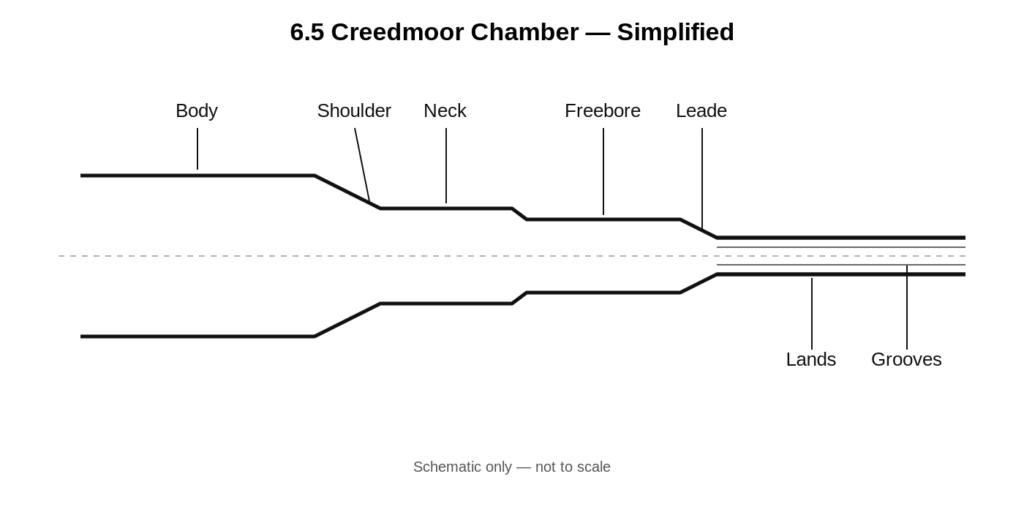
That is really all freebore is. But its dimensions can have a significant influence on how a cartridge and chamber work together.
Why Freebore Length Matters
Freebore has both a length and a diameter.
The length determines how much cylindrical, unrifled space exists in front of the chamber neck before the leade begins. That matters because different bullet designs place the ogive—the curved portion of the bullet nose—in different locations. Modern long-range bullets often have long, tapered ogives. Older bullets may have much shorter, more rounded noses. One of the jobs of freebore is to provide enough room for the intended bullet to be seated where the cartridge designer wants it without forcing the bullet into the rifling when the cartridge is chambered.
The classic 7×57 Mauser is a good example. The cartridge was originally designed around a heavy round-nose military bullet of roughly 175 grains. Because that bullet had a very different nose shape from today’s long, sleek bullets, the chamber needed significant throat length to accommodate it. The 6.5×55 Swedish is another older cartridge with similar history and relatively generous throat geometry. The important point is that bullet length alone does not determine required freebore. What matters is the relationship between the seated bullet and the point on its ogive that reaches approximately full bullet diameter. A long, sleek bullet with a tapered nose can interact with the rifling very differently from a shorter, blunt round-nose bullet.
Freebore Diameter Matters Too
Length gets most of the attention, but freebore diameter can be just as important. Ideally, I want relatively little clearance between the bullet and the freebore. Why?
Because the bullet has to transition from the cartridge case into the rifling. If there is excessive clearance around the bullet as it leaves the case, the bullet has more opportunity to become slightly misaligned before it engraves into the rifling. That misalignment is sometimes described as principal axis tilt.
A tightly controlled freebore helps keep the bullet aligned with the bore as it begins its trip down the barrel. This is one of the reasons a properly designed custom chamber can sometimes make an older cartridge perform much more like a modern precision-oriented cartridge. You have not changed the cartridge case. You have improved the geometry around it.
Designing Freebore Around the Bullet
When designing a custom chamber, freebore does not have to be an arbitrary dimension. It can be designed around the bullet you actually intend to shoot. I am currently doing exactly that with a custom .264 Winchester Magnum. I want the bullet seated so that the bottom of its bearing surface is approximately at the neck-shoulder junction. That lets me use essentially the full length of the case neck to support the bullet’s bearing surface. From there, I can measure the geometry of that particular bullet and design the freebore length so the loaded cartridge begins with roughly .030 inch of bullet jump.
I can also specify a very tight freebore diameter so the bullet has very little room to move laterally before entering the rifling. That means the chamber is being designed as a system around:
- the bullet
- the desired seating position
- the case neck
- the intended bullet jump
- and the alignment of the bullet with the bore
That is a very different approach from simply accepting whatever chamber dimensions happen to exist.
Freebore Is Not Bullet Jump
Freebore and bullet jump are related, but they are not the same thing.
Freebore is part of the chamber. Bullet jump is the distance the seated bullet travels before its ogive begins engaging the rifling.
You can change bullet jump simply by changing seating depth. The freebore has not changed at all. There is no universal correct amount of bullet jump. A handloader may run a bullet touching or even slightly jammed into the lands, or the bullet may jump several hundredths of an inch—or considerably more—before engaging the rifling. A lot of handloaders begin somewhere around .020 to .050 inch off the lands, but that is only a starting point, not a rule. Different bullets and different chambers can behave very differently.
Freebore, Leade, and Throat
You will also hear the terms freebore, leade, and throat used when people talk about chambers. They are related, but they are not exactly the same thing. The freebore is the cylindrical section ahead of the chamber neck. The leade is the angled transition where the rifling progressively reaches full height.
The term throat is often used more generally for the area where the chamber transitions into the rifling. The term throat is also used somewhat inconsistently. SAAMI uses throat essentially synonymously with leade, while shooters, gunsmiths, and handloaders sometimes use “throat” more loosely for the entire area ahead of the case neck, including the freebore and leade. That inconsistent usage is one reason these discussions can become confusing.
Freebore and Pressure
Bullet position relative to the rifling also affects pressure. A bullet that begins touching or jammed into the lands encounters engraving resistance immediately when pressure begins building. That will generally produce higher pressure than the same load with the bullet seated slightly farther from the rifling.
As bullet jump increases, pressure will generally decrease for a time because the bullet is able to begin moving before it has to engrave into the rifling. That trend does not continue forever. If the bullet is seated extremely deeply, eventually the reduction in usable powder space can begin increasing pressure again. In most normal bottleneck rifle cartridges, however, that requires much more dramatic seating-depth changes than the small adjustments handloaders normally make while experimenting with bullet jump.
This is also one reason I consider a chronograph such an important handloading tool. Velocity is a function of pressure. A chronograph cannot tell you the exact chamber pressure in PSI, but changes in velocity can provide useful information about what your load is doing as you change seating depth or other components.
The Bigger Picture
Freebore sounds like a tiny technical detail. It is not. Its length helps determine how a particular bullet fits the chamber. Its diameter can influence how well that bullet stays aligned as it enters the rifling. And together with bullet seating depth, neck geometry, leade angle, magazine length, and bullet shape, it becomes part of the larger system that determines how well a cartridge and rifle work together. Understanding freebore is really just another example of the larger principle behind rifle accuracy:
The individual pieces matter, but they matter most because of how they interact.
If you want to see how chamber geometry fits into the larger rifle system, read Modern Cartridge Design, What Is Muzzle Velocity?, and What Are Extreme Spread and Standard Deviation?