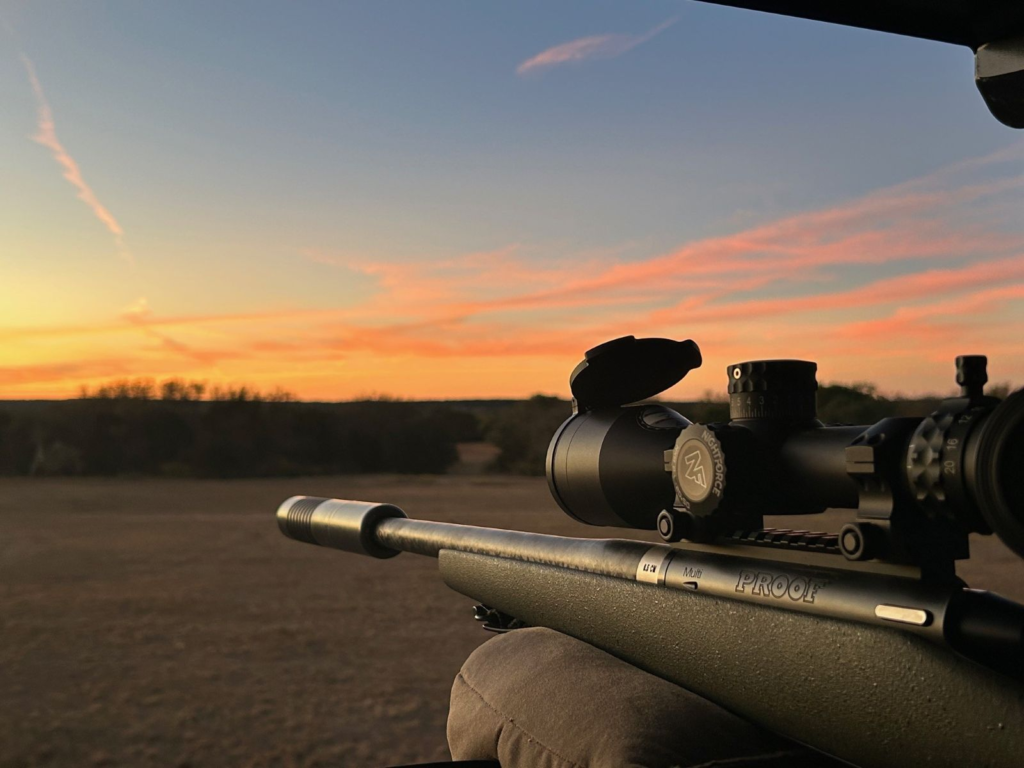
It’s a question I’ve been asked more times than I can count over the years. Someone buys a new hunting rifle and wants to know what scope they should put on it. And my answer usually starts with another question. How far are you planning to shoot, and do you anticipate shooting farther in the future?
That question tells me considerably more about what someone needs than asking what rifle they’re buying, what cartridge they’re shooting, or how much magnification they want.
I think most hunters make selecting a riflescope more complicated than it needs to be. They compare magnification ranges, objective sizes, tube diameters, reticles, and features without first asking which of those things matter for the hunting they actually do. Often, the differences they’re debating won’t make much difference in their ability to make the shot.
How Far Are You Really Going to Shoot?
Let’s start with someone hunting whitetails from a deer stand, with most shots inside 150 or 200 yards. What does that hunter actually need? Probably less than they think. A fixed 4-power scope could handle many of those situations. So could a traditional 3-9x scope or any number of other reasonable options.
At those distances, a hunter doesn’t necessarily need a sophisticated reticle, exposed elevation turrets, a zero stop, or particularly high magnification. What they need is a reasonably well-made scope that holds zero and provides a clear, usable sight picture.
For that kind of hunting, my advice is usually simple: buy a reasonably well-made scope from a reputable manufacturer that fits your budget. There’s a point at the very inexpensive end of the market where durability and consistency become legitimate concerns, and a scope that won’t hold zero is no bargain. Beyond that, though, hunters can spend a lot of money on features they’ll seldom use.
The more important question is whether the hunter actually understands where the rifle is shooting. We’ll come back to that.
What Changes When the Distances Get Longer?
Now change the situation. Instead of someone who rarely shoots beyond 150 yards, imagine a hunter who may encounter shots at 400 or 500 yards and is willing to develop the skills those distances require. That’s when I start looking for additional capabilities.
The first is a reticle with meaningful measurements. I want a reticle with known MOA or MIL subtensions that I can use to hold for wind, measure the relationship between my point of aim and an impact, and make accurate corrections. I don’t want to guess how far to hold off an animal because the wind is blowing. I want to have some understanding of what that hold actually represents.
The second capability is reliable elevation adjustment. I want to be able to dial the elevation correction required for the distance I’m shooting, trust that the scope moved the amount I requested, and know that it will return to the same zero when I dial back down. That last part is extremely important.
Exposed turrets alone don’t make a scope suitable for dialing. They must track consistently and return to zero. For longer-range hunting, a measuring reticle and reliable elevation adjustments are the first two capabilities I want.
Notice that I haven’t said anything about needing 25 or 30 power. Magnification can be useful, but accurate, repeatable corrections become much more important as distances increase.
What About First and Second Focal Plane?
This is one of those subjects that hunters can spend an enormous amount of time debating, but the answer really depends on how they intend to use their scope. A first focal plane reticle maintains its measured subtensions at every magnification. If a mark represents half a MIL at 10-power, it still represents half a MIL at 20-power. That makes it very useful when holding for wind or measuring corrections at different magnifications.
The tradeoff is that the reticle becomes visually smaller as magnification decreases. At low power, some of the finer markings can become difficult to see, particularly in poor light.
A second focal plane reticle maintains the same apparent size as magnification changes. That can make a simple hunting reticle easier to see at lower magnifications, but the measured subtensions change their angular values as magnification changes.
Both systems work; they just make different compromises. If a hunter isn’t using measured holds, the distinction may not be particularly important. If they regularly hold for wind or measure corrections, it matters a great deal.
We’ve covered the mechanics of these two systems in much greater detail in our article First Focal Plane vs. Second Focal Plane. The important thing here is to understand how you intend to use your reticle before deciding which system makes more sense.
How Much Magnification Do You Really Need?
I personally prefer scopes with substantial magnification ranges. My favorite hunting optic is a 4-32x, but I don’t hunt at 32-power. I’m usually around 12-15x when hunting and closer to 18× when shooting competitions. At the range, though, having 32x available lets me inspect what’s happening on a 100-yard target without reaching for a spotting scope. I also appreciate the additional magnification when shooting groups.
That’s a convenience I really appreciate. But there’s another reason I don’t simply turn the scope to maximum magnification when hunting. I want to be able to stay in the scope and observe what happens when I fire. If I can spot my own impact, I have information about what happened to that shot. If I lose the target in recoil, I lose that information.
Field of view matters for that reason, and increasing magnification generally narrows the field of view. There’s also the question of reticle visibility. Because I use a first focal plane optic, I need enough magnification to clearly distinguish the subtensions I intend to use. For me, the magnification setting is a balance between seeing the target, seeing the reticle, maintaining sufficient field of view, and being able to observe the shot.
That doesn’t mean a lower-magnification scope can’t offer a perfectly usable first focal plane reticle. There are some excellent lower-power optics with reticles that remain easy to see and use throughout their magnification range. Some of those reticles are simpler and provide fewer measured reference points than I personally prefer. I like having more information available for my holds, but that’s a matter of personal preference, not a requirement for successful hunting.
A hunter who never shoots beyond 150 yards may have entirely different priorities. That’s fine. The goal isn’t to select the scope with the most magnification. It’s to select an optic with a useful magnification range for the work you intend to do.
Don’t Get Too Caught Up in Objective Size
One of the most persistent assumptions in scope shopping is that a bigger objective automatically means a brighter scope. It doesn’t. Objective diameter and main-tube diameter alone are poor predictors of how clear or bright the finished image will look. Optical design, glass, coatings, magnification, and the way the whole system works together matter enormously.
I’ve worked in optics for many years, including more than a decade at Leupold before moving to Nightforce. One of the brightest scopes I encountered in that work was a low-powered 1-6x model with a relatively small objective. That experience is one reason I don’t use objective size as a shortcut for judging low-light performance.
Objective size can play a role in optical performance under particular conditions. It just doesn’t tell you, by itself, which scope will let you see best. What matters is the sight picture at the magnifications and in the light where you actually hunt. Can you distinguish detail? Can you see your aiming point? Those are much better questions than whether the objective says 44, 50, or 56 mm.
Can You See the Reticle in Low Light?
There’s another low-light issue that doesn’t receive nearly enough attention. Sometimes you can see the animal perfectly well through your scope but struggle to see the reticle against it. I’ve encountered that situation many times. An illuminated reticle would seem to be the obvious solution, but I’ve never been particularly fond of them. In fact, almost every scope I own has illumination, and I can’t remember the last time I turned one on.
My problem is that illuminating the reticle can actually make the sight picture worse. Even at relatively low settings, I’ve found that some systems introduce glare or a colored haze around the reticle. In extremely low light, that can make the animal more difficult to distinguish, defeating the entire purpose of turning on the illumination.
I prefer the clean contrast of a sharp black reticle. One exception I’ve liked is Leupold’s FireDot, which can give you a subtle illuminated center point without lighting up the entire reticle. Many of the FireDot configurations I’ve used or seen were simpler reticles, however, without the measuring subtensions I want for longer-range shooting.
That’s the tradeoff for me: I want to see the reticle clearly, but I also want it to work as a measuring tool. Illumination has its uses; it isn’t automatically an improvement. And if I can’t clearly identify my aiming point in fading light, I won’t force the shot.
Reliability Matters More Than Weight
If there’s one thing I’m particularly unwilling to compromise on, it’s the mechanical reliability of my scope. I’ve spent enough years shooting and hunting to develop a strong appreciation for optics that maintain zero and continue functioning after hard use.
Hunting equipment gets bumped, knocked around, and sometimes dropped. I want a scope that can take ordinary field abuse and still hold zero. I’m willing to carry some additional weight for that confidence. That doesn’t mean all heavier scopes are durable or all lightweight scopes are fragile. Weight isn’t a substitute for evidence of reliability.
I’d encourage hunters to look beyond advertising and consider how well an optic holds zero after impacts and repeated adjustments. Rokslide’s scope field evaluations are one useful source of that sort of information, though any individual test has limits. A scope can have wonderful glass and every feature you might want. But if your bullets don’t consistently impact where you expect them to, those features mean very little.
What About the Weight of the Entire Rifle?
People sometimes focus so much on removing weight that they overlook how the complete rifle shoots. A very light rifle can be harder to hold steady and manage through recoil, particularly with more cartridge than the job calls for. That can also make it harder to stay in the scope and see an impact.
I tend to prefer a complete hunting rifle system weighing somewhere around 12 to 14 pounds. And when I say complete, I mean everything: rifle, scope, suppressor, bipod, sling, magazines, ARCA rail, and whatever other accessories I’m actually carrying.
The reason I bring this up is that I think many hunters place too much emphasis on the weight of their scope. Personally, I’d rather choose the optic that provides the features, functionality, and reliability I want than compromise those things to save a few ounces. Chasing the lightest possible scope to complement an already lightweight rifle can sometimes be counterproductive, particularly when the resulting system becomes more difficult to shoot well.
That’s my preference, not a target weight everyone should adopt. A hunter covering steep country all day may reasonably place a higher priority on reducing weight. Every hunter has different needs, and the important thing is to understand the trade-offs rather than simply chasing an arbitrary number on a specification sheet.
Do You Need a Zero Stop?
I don’t consider a zero stop absolutely necessary, but I certainly prefer having one. Once you’ve used a good zero-stop system, it’s difficult to want to go back. A zero stop makes returning to your established zero simple and helps eliminate the possibility of being a full revolution off on the elevation turret. Without one, you need to understand what your turret looks like at zero and how to recognize when it’s on the wrong revolution.
On many scopes, the turret rises as elevation is dialed, changing the gap between the bottom of the turret and the scope body. Learning to recognize that physical position can help identify a revolution error. That’s something worth practicing before going hunting.
I also hear concerns about exposed turrets getting bumped off their settings in the field. After decades of hunting, including in mountainous terrain, I haven’t personally had that happen. It certainly can happen, and shooters should check their settings, but it wouldn’t be my deciding factor. I like a zero stop because it makes returning to zero simple.
What About Parallax?
Parallax is another subject shooters tend to make much more complicated than necessary. The adjustment brings the target image into the reticle’s focal plane, reducing apparent movement between the two when your eye shifts behind the scope. The key question for a hunter isn’t whether any error is theoretically possible. It’s whether the error is big enough to matter under realistic conditions.
If you’d like a better understanding of how parallax works, we’ve covered the basics in our CPO Short, What Is Parallax on a Rifle Scope?
For much of my hunting, I set parallax toward the far end of its adjustment range and leave it alone. With that setting, at ordinary hunting distances and with a reasonably centered eye, the resulting aiming error is generally very small relative to a big-game animal’s vital area.
I’ve sometimes heard shooters blame a complete miss on parallax. In normal big-game hunting situations, I’m skeptical. The geometry of the optical system puts practical limits on the error, and typical eye positions are nowhere near the theoretical extreme. Before blaming parallax, I’d look at the zero, the shooting position, and the shooter’s execution.
Parallax still matters when you’re chasing very small targets or working with unusual focus and distance combinations. But those cases shouldn’t be confused with an ordinary shot on a deer. I’d rather see hunters understand the scale of the effect than constantly worry about getting the dial perfectly matched to every distance.
The real point of this is that if your scope has a reasonable parallax setting, and you’re mostly square and centered behind your rifle with a decent cheek weld, you’re not going to have much error in where the bullet impacts. Of course, this is assuming a very good zero.
None of This Matters Without a Real Zero
We’ve spent a lot of time discussing what to look for in a hunting scope. But I want to come back to something that I consider far more important than any of the features we’ve discussed. You need to know where your rifle actually shoots.
And I don’t mean having the gun store bore-sight it. Bore-sighting is a way to get close enough to start firing on paper; it isn’t a zero. Neither is firing one shot, turning a turret, firing another, adjusting again, and assuming you’re done because the next bullet landed near the center. That’s chasing individual impacts, not establishing the rifle’s actual point of impact.
Every rifle produces some amount of dispersion, which can be visualized as a cone of fire. Individual shots won’t land in exactly the same location, even when the rifle and shooter are performing consistently. A meaningful zero requires shooting enough rounds to understand where the center of that dispersion actually falls, then adjusting the optic based on that information.
Without that information, an expensive scope still won’t tell you reliably where the bullet will land. For the hunter inside 150 or 200 yards, a true zero and an understanding of the rifle’s trajectory are probably more valuable than another round of scope upgrades.
So, What Scope Should You Buy?
If you’re hunting at relatively short distances, the answer may be much simpler than you expected. Buy a reasonably well-made scope from a reputable manufacturer that fits your budget. Make sure it provides a usable sight picture, maintains zero, and has enough magnification for the distances you intend to shoot. Then learn how to use it.
If you’re planning to shoot at extended distances, the requirements begin to change. A measuring reticle, reliable elevation adjustment, and a repeatable return to zero become much more valuable.
The features we’ve discussed—focal plane, field of view, reticle visibility, optical performance, durability, and weight—all involve trade-offs. You don’t need to understand every detail of riflescope design to choose a useful hunting optic. Start with the distances you intend to shoot, identify the capabilities those distances require, and take the time to understand the features that matter for your particular application.
A scope is only one part of a complete shooting system, and more features don’t automatically make that system better. The goal isn’t to buy the most impressive collection of specifications. It’s to understand what you need your scope to accomplish, choose accordingly, and learn how to use it.
Understanding your reticle is an important part of choosing the right scope. Learn how the two systems work in First Focal Plane vs. Second Focal Plane.
Before heading into the field, make sure you understand how your rifle’s zero affects its trajectory in How Far Should I Zero My Hunting Rifle?
If you’re unfamiliar with parallax and how it affects your sight picture, start with our CPO Short, What Is Parallax?
And remember, the optic is only one part of the complete shooting system. Explore the considerations that go into choosing a rifle in What Rifle Should I Buy?