
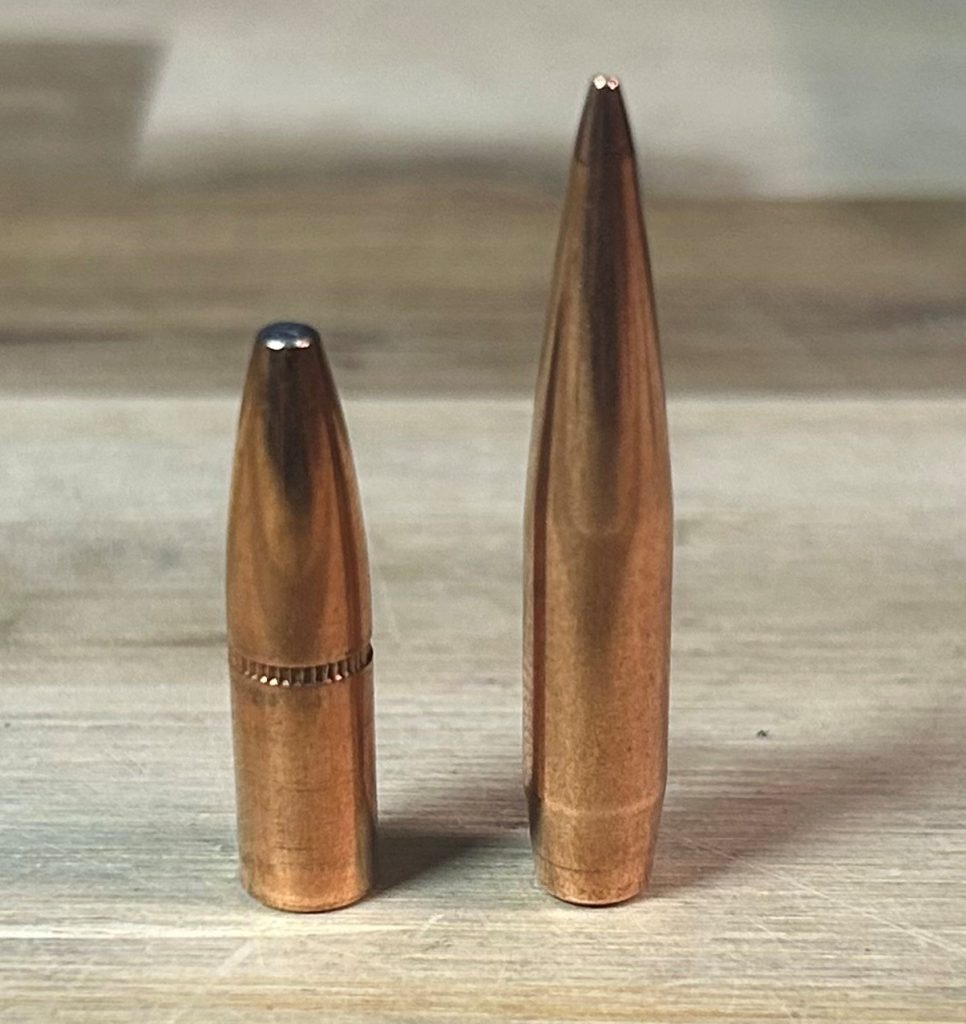
What is a ballistic coefficient? When I’ve done training classes, this question comes up more often than you would imagine, and I understand why. It’s a rather abstract idea at face value, and I don’t think the industry really explains what it is or what it does very well. We jump straight into complex terms and mathematical equations. If I typed that question into Google, I’d guess I’d be bombarded with a lot of technical, math-heavy answers, but I don’t think that’s what people are asking when they frame this question at the range. I think they want to know intuitively what a BC is and what that number represents, so they understand why they’re using it and what it means to their system.
What Determines Ballistic Coefficient?
So imagine you have two identical-sized balls in your hand. One is a ping-pong ball, and the other is the same exact size, but it’s made of steel. Now launch both of these balls at exactly the same speed. Which one will slow down faster, and which one will fly farther?
That simple visualization is ½ of BC explained in one simple description. Now let’s connect the second half. If you know the steel ball will slow down more slowly than the ping-pong ball, what happens if I change its shape to something much more aerodynamic, like a bullet shape, but it has the exact same mass as the steel ball? Now, if I launched the round ball and the aerodynamic projectile at exactly the same speed, which one would slow down faster? Obviously, the ball is going to lose speed much quicker.
Ok, so now you understand a simple concept. If you have two identical balls, but one has more mass, the lighter one slows down much quicker. When talking about BC, we’ve just demonstrated the effect of sectional density: the relationship between weight and diameter. Now if you have two items with the same mass, one with an aerodynamic shape and the other our original steel ball, the steel ball will slow down faster because it has a lot more drag. When developing a BC, that difference in aerodynamic efficiency is represented by form factor.
So we need to understand two concepts here that work together to form our BC. Half of it is weight, and the other is shape. As we noted above, if two things are identical in size and shape, the lighter one will slow down quicker. And if we have two items that are exactly the same weight, but one is more aerodynamic, the other item will slow down much quicker. I’m driving this home because we need to lock down that there are two individual sides to BC, and both of them determine the final BC number.
How Is Ballistic Coefficient Determined?
But how do we actually put a number on that? BC use began long before we had much in the way of computers, and if you were going to shoot something a long way away, how would you know the trajectory? The math to figure out a trajectory was known, but without the aid of computers or the luxury of ballistic solvers, it would have been incredibly laborious to figure out how each individual bullet flew. The simplest answer was to do the complex work of establishing how a known projectile behaved, then compare your projectile’s flight characteristics to that known standard, giving you a ratio you could use to predict how yours would fly. This was done mostly for artillery rounds, but it was scalable to rifle projectiles.
This is essentially where the G1 standard came from. It was a projectile that had been laboriously measured for exactly how it flew and how drag affected it. Then people could just compare their bullet to the known standard.
What Are G1 and G7 Ballistic Coefficients?
So now we have a basic understanding of what the BC is; let’s talk about G1 and G7 references. The simplest way to think of them is as shapes. A G1 reference is just a fairly blunt-nosed projectile with a flat base, while a G7 reference is a streamlined tapered-nose projectile with a long boattail. This is important because we’re going to compare our modern bullets to one of these shapes to determine our BC.
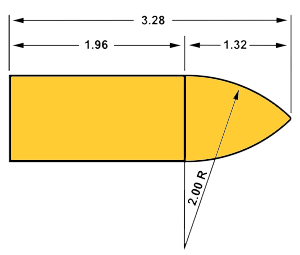
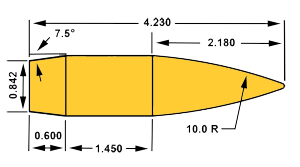
G1 and G7 standard projectile illustrations: Francis Flinch / Wikimedia Commons, licensed under CC BY-SA 3.0.

People often wonder why two different numbers exist, or even what they represent. The best way to think of that is that we’re using a different ruler. If I measure something with a yardstick and then measure the same thing with a meter stick, I’ll get two different numbers. Did the object change length? Of course not. I simply used a different standard to describe it. That’s a simple way to think about the difference between a G1 and G7 BC. We’re describing the same bullet using two different references, or, to use our analogy above, different rulers.
Let’s go back to my original example of two projectiles with the exact same mass but different shapes. So, simply, G1 and G7 give us two different reference shapes to compare our projectile to. Depending on the shape of the projectile you’re shooting, picking the reference projectile that’s closest to yours is a good idea. If you’re shooting a short, flat-based bullet that isn’t super pointed, a G1 is probably the right choice. If you’re shooting a streamlined, pointed bullet with a boattail, the G7 will work for you.
What Does the BC Number Mean?
We’ll have to get a little technical here, even though I’m trying not to go there. Regardless, BCs give us a number. What is that number? Remember the two things we just talked about, sectional density and form factor? The BC number is simply those two things combined mathematically. We divide the bullet’s sectional density by its form factor, and the result is its ballistic coefficient. A larger BC number tells the solver that our bullet will lose velocity more slowly, while a smaller BC tells it that the bullet will lose velocity more quickly.
Why Does Ballistic Coefficient Matter?
So the simple part is, when you understand what a BC is, you can decide what you need for your own system. Are you looking to shoot a long way away? If so, that larger BC number absolutely applies to you. The bullet with the larger BC slows down more slowly, so it has a flatter flight (actually called better velocity retention) and less wind drift. If you’re just shooting shorter ranges, BC is much less of a variable you have to worry about.
A lot of people go straight to picking the bullet with the highest BC possible, and that’s not necessarily wrong, as long as the rest of the bullet is up to the job you want it to do. For example, hunting bullets don’t always have amazingly high BCs compared to match bullets, but a match bullet won’t always accomplish what you want terminally. As with any system, it’s important to look at the whole picture of what you’re trying to achieve before choosing what you want to use.
And really, that’s it. You can dig into the more technical side of BC from what I’ve presented here, and you can go down the mathematical rabbit holes and learn all the technical jargon. There’s nothing wrong with having a deeper understanding, but honestly, if you understand these concepts, you now have the framework to choose the right tool for whatever you’re trying to accomplish. Sometimes I find simple is best.