
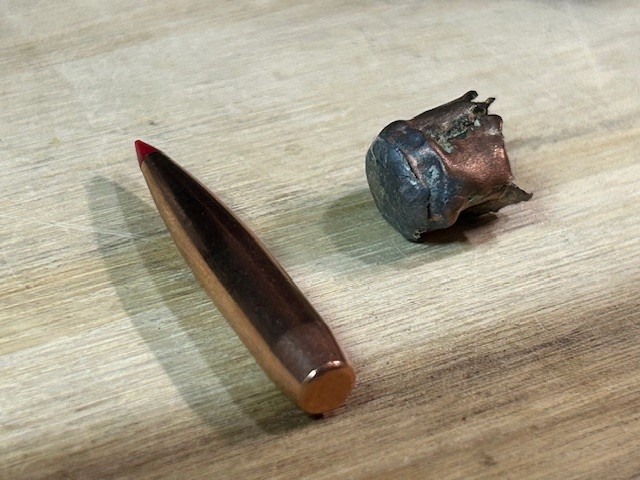
Every Bullet Has an Operating Window
Throughout this series, we’ve spent a great deal of time discussing how bullet construction influences terminal performance. Jacket thickness, core hardness, bonding, partitions, and monolithic construction all determine how a bullet is intended to behave after impact.
Construction, however, is only half the equation.
Every bullet is designed to operate within a particular impact velocity window. Construction determines how a bullet behaves. Impact velocity determines whether it behaves the way its designer intended.
Strike an animal above that operating window and a bullet may upset more violently than intended, fragment excessively, or lose more weight than the engineer planned. Strike below that window and the bullet may not upset enough to produce the wound channel it was designed to create.
There are no universal velocity limits because every bullet represents a different engineering solution. As a general guideline, many modern hunting bullets need somewhere around 1,800 feet per second or more before they upset reliably, although some are designed to work at lower velocities and others require more. Upper velocity limits vary even more dramatically depending on construction. Some conventional bullets can become excessively destructive at very high impact velocities, while controlled-expansion designs may tolerate considerably more. Every design is different.
That’s why manufacturers often publish minimum impact velocities for their bullets. They are telling you the speed at which that particular design begins performing as intended.
Velocity Versus Energy
Hunters often discuss kinetic energy as though it predicts terminal performance. I don’t think it does. Energy is absolutely real. Every bullet carries kinetic energy, and that energy ultimately allows work to be done inside the animal. The problem is that energy alone doesn’t tell us how that work will be accomplished. Consider two very different examples.
A .338 Lapua Magnum firing a 300-grain full metal jacket produces enormous energy figures. Yet if that bullet passes through the chest of an elk without upsetting it, it may leave little more than a caliber-sized hole while carrying substantial remaining energy with it as it exits the animal.
Now compare that to a .223 Remington firing a 77-grain Tipped MatchKing. On paper, the energy numbers are dramatically lower, yet the bullet can create a remarkably destructive wound channel because its construction causes it to upset and fragment after impact.
The available energy is only part of the story. Bullet construction determines how that energy is used. That is why impact velocity is such a valuable metric. Unlike energy, which cannot tell us how a particular bullet will behave, impact velocity can be directly compared to the operating window for which the bullet was designed.
If I know my rifle launches a particular bullet at 2,800 feet per second, I can use a ballistic calculator to determine exactly how fast that bullet will be traveling at any distance. If the manufacturer recommends a minimum impact velocity of 1,800 feet per second, I now have a practical way to determine the maximum range at which that bullet is expected to perform as designed.
Personally, I prefer not to operate right at the edge of any window. If a bullet is rated for reliable upset at 1,800 feet per second, I’d rather build in some margin and plan around 2,000 feet per second. That extra cushion increases the likelihood that the bullet will continue performing consistently under real hunting conditions.
Once again, we’re back to the same principle that has guided this entire article. Construction determines how a bullet behaves. Velocity determines whether it behaves as designed.
How does a bullet actually kill an animal?
At first glance, the answer seems obvious. We shoot the animal; it dies. But the mechanics behind that process are worth understanding because they help explain why different bullets can produce very different terminal performance.
Ultimately, a bullet kills by destroying tissue the animal needs to survive. Where that damage occurs, how much tissue is destroyed, and how quickly normal physiological function is lost determine what happens after the shot.
The most immediate mechanism is disruption of the central nervous system. If a bullet destroys the brain or upper cervical spinal cord, the animal can be immediately incapacitated.
More commonly, a bullet passes through the chest and damages vital organs and blood vessels. A severely damaged heart can no longer circulate blood effectively. Damaged lungs can no longer exchange oxygen efficiently. At the same time, damage to arteries, veins, capillaries, and highly vascular organs causes blood loss.
As blood volume falls, the circulatory system becomes progressively less capable of delivering oxygen to the brain and other vital organs. Eventually, the animal loses consciousness, and the organs can no longer sustain life.
This is also why animals often run after being shot. A bullet passing through the chest does not necessarily cause immediate incapacitation. Even a fatal wound may leave the animal capable of purposeful movement for a period of time while blood loss and loss of circulatory function progress. Understanding that helps explain why even a perfectly placed shot may not produce an instant collapse.
Temporary Cavity and Permanent Cavity
To understand how different bullets create different wound channels, we first need to understand the difference between the temporary cavity and the permanent cavity.
When most expanding hunting bullets strike an animal, the resistance they encounter begins slowing them immediately while also driving the bullet’s upset. As the nose begins to open, its increasing frontal diameter creates even more resistance, causing the bullet to slow more rapidly. Most of that deformation occurs very early in the wound track, while the bullet still has enough velocity for those forces to overcome the strength of its construction. Once the bullet has slowed sufficiently, upset largely stops and the bullet continues penetrating at its expanded diameter.
Not every bullet follows exactly the same pattern. Some designs delay upset. Berger’s Hunting VLD is a good example. Its long, narrow nose can penetrate several inches before the thin nose collapses. Once that happens, upset and fragmentation occur very rapidly. The important point is that there isn’t a universal distance at which every bullet completes its upset. Construction and impact velocity determine how and when that happens.
If you’ve ever watched high-speed video of ballistic gelatin, you’ve probably noticed the large bubble that forms around the bullet as it travels through the block. That bubble is the temporary cavity. It is created as material is rapidly displaced away from the bullet’s path. In an animal, tissue stretches outward before collapsing back toward its original position after the bullet passes. By itself, however, that stretching doesn’t necessarily represent permanent damage. How much damage it causes depends heavily on the tissue involved. More elastic tissues can tolerate considerable stretching, while less elastic tissues can be damaged by it.
The permanent cavity is different. The permanent cavity consists of tissue that the bullet actually crushes, cuts, tears, or otherwise destroys as it passes through the animal. Fragmenting bullets can also increase the amount of permanently damaged tissue as fragments travel away from the bullet’s primary path. This is tissue that does not recover after the bullet has passed.
The permanent cavity is generally much smaller than the maximum temporary cavity. That distinction is extremely important because many people confuse the two. A dramatic temporary cavity in ballistic gelatin does not mean that everything inside that cavity would have been permanently destroyed in an animal.
Why Fragmentation Changes Everything
Now let’s go back to something we’ve discussed several times throughout this article. Imagine a rubber band lying loosely on a table. If you drag a knife across it, the rubber band simply moves out of the way. You might leave a small nick, but it doesn’t immediately break. Now stretch that same rubber band until it’s almost at its breaking point. Touch it with the same knife. This time it snaps almost instantly. The difference isn’t the knife. The difference is the amount of tension already present in the rubber band. The same basic principle applies inside an animal.
As the temporary cavity stretches tissue outward, blood vessels, connective tissue, and organs are placed under tension. Depending on the type of tissue and the amount of stretch, much of it may rebound after the temporary cavity collapses. But if small fragments from a bullet pass through that stretched tissue while it is under tension, they can sever blood vessels and tear tissue that otherwise might have recovered. In other words, portions of the temporary cavity can become part of the permanent wound.
That is one reason some fragmenting bullets can create dramatically different wound channels than bullets that retain nearly all of their weight. Neither approach is automatically superior. A bullet that retains nearly all of its weight may provide exceptional penetration and reliable exit wounds. A bullet that sheds some material may create a larger permanent wound cavity while still providing adequate penetration for the intended application. Once again, we’re back to the same question that has guided this entire article.
What terminal performance are you trying to achieve?
Different bullet designs answer that question in different ways. Understanding how temporary and permanent cavities are formed helps explain why those designs can produce very different results in the field. The goal isn’t to decide which design is best. It’s to understand what a particular bullet actually does, then decide whether that behavior matches what you want it to accomplish.
Start With the End in Mind
If you’ve made it this far, you’ve probably realized something. I still haven’t told you what bullet to buy. That’s intentional. The purpose of this article was never to convince you that one bullet is better than another. It was to help you understand why different bullets exist and what each one is trying to accomplish.
So where do we go from here? Start with the answer. Before you ever look at a catalog, compare ballistic coefficients, or start arguing about brands on the internet, ask yourself one simple question: What do I want this bullet to do? Even better, ask yourself: What do I want the wound channel to look like? That’s really the end goal.
Everything we’ve discussed throughout this article comes back to that one question. Do you want a bullet that creates a broad, aggressive wound channel but doesn’t necessarily retain all of its weight? Do you want deep penetration and an exit wound? Would you rather maximize tissue disruption, or would you rather ensure the bullet reaches the far side of the animal under almost any circumstance? None of those answers are wrong. They’re simply different objectives.
Once you’ve answered those questions, choosing a bullet becomes much easier because you’re no longer shopping for the “best” bullet. You’re looking for the bullet whose terminal behavior best matches the result you’re trying to achieve.
Let’s look at a simple example. Suppose you’re hunting whitetails in the eastern United States. A mature deer simply isn’t very thick. A broadside deer doesn’t require extraordinary penetration to reach and pass through the vital organs. If you’re hunting smaller properties where you hope the deer doesn’t travel far before expiring, you may decide that a rapidly upsetting bullet that creates an aggressive wound channel best matches your priorities.
Now consider a different hunt. You’re chasing elk in wide-open country out West. You may still want an aggressive wound channel, but now you may also want enough penetration to handle a quartering shot, break a shoulder, or reach the vital organs from a less-than-perfect angle. Maybe you also place greater value on an exit wound because you could be following a blood trail through dark timber. Those priorities might lead you toward a bullet that gives up some of the rapid upset you wanted on the deer in exchange for greater penetration.
That doesn’t necessarily mean you need an entirely different bullet. The same bullet may provide both. The point is that you’re starting with the terminal result you need and then looking for a bullet whose behavior matches it. The point isn’t which answer you choose. The point is that you’re now making that decision intentionally.
One thing I’ve noticed over the years is that many hunters spend a tremendous amount of time worrying about whether a bullet will penetrate deeply enough. With modern hunting bullets, I think that concern is often overstated. On an animal the size of a deer, virtually every hunting bullet we’ve discussed will provide enough penetration to reach the vital organs, particularly at impact velocities above 2,000 fps. The more meaningful question usually isn’t, Will it get there? It’s: What will it do once it gets there?
That brings us full circle. Throughout these articles, we’ve talked about jacket construction, core hardness, bonding, partitions, monolithic bullets, match bullets, fragmentation, temporary cavities, and permanent cavities. None of those topics were the destination. They were simply the tools we needed to answer one final question.
What kind of wound channel do I want to create?
Once you can answer that question, selecting the right bullet becomes far less confusing.
Related Reading
- Understanding Bullet Design: How Construction Determines Terminal Performance — The foundation of the series, explaining why bullet selection should begin with the terminal result you want to achieve.
- Understanding Bullet Design, Part 2: Bullet Construction — How cup-and-core, bonded, partitioned, monolithic, and match bullets are built, and how those design choices influence terminal behavior.
- What Is Ballistic Coefficient? — How bullet shape and drag affect velocity retention, and why retained velocity matters when evaluating terminal performance at distance.