
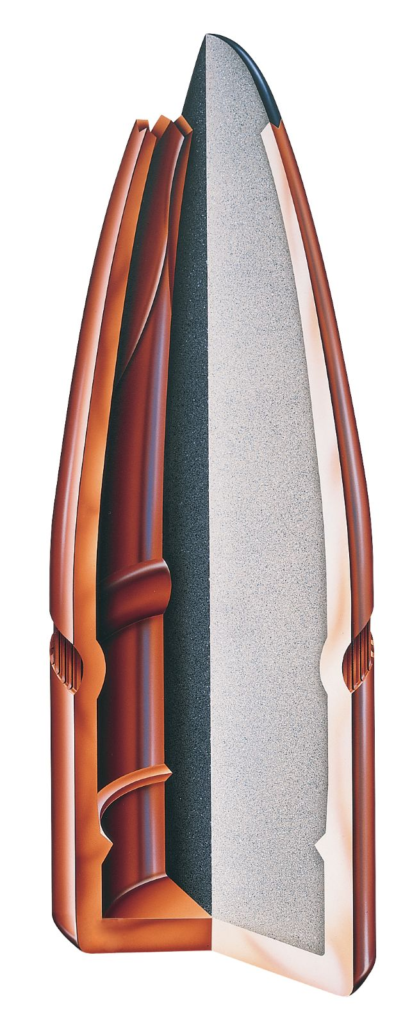
The Original Bullet: Cup-and-Core
Before we can understand why bullets are built the way they are today, it helps to understand how we got here. Bullet design is really a history of solving problems. Someone identifies something that isn’t working the way they want, then begins asking how to fix it. Each solution creates a new set of strengths, limitations, and tradeoffs.
The best place to start that story is with the original cup-and-core bullet.
When smokeless powder replaced black powder, rifle velocities increased dramatically. All of a sudden, the simple lead bullets that had worked reasonably well before were no longer a great solution. If you’ve done much handgun shooting with cast lead bullets, you may have seen this yourself. In my own revolvers, I’ve seen hard-cast bullets begin smearing lead into the bore once velocities climbed much beyond roughly 800 or 900 feet per second. That isn’t a universal velocity threshold—bullet hardness, fit, lubrication, and the firearm itself all matter—but it illustrates the problem. As velocity and pressure increase, keeping bare lead from depositing in the bore becomes increasingly difficult.
The same basic problem confronted early rifle-bullet designers. As smokeless powder allowed substantially higher rifle velocities, the lead projectile needed protection from the much harsher conditions of launch and travel through the bore. The solution was to surround the lead core with a metal jacket. Several materials were tried, but copper alloys eventually became standard, with gilding metal becoming one of the dominant jacket materials.
Gilding metal is generally about 90 to 95 percent copper, with the remainder mostly zinc. The exact formula can vary, but that small amount of zinc changes the way the material behaves. Pure copper is relatively soft and tends to be sticky as it travels through the bore. It can create more fouling and friction than gilding metal, which can also influence pressure. Adding zinc produces a jacket material that is harder, less prone to fouling, and better suited to the demands of a high-velocity rifle bullet.
There have been, and still are, some bullets made with pure-copper jackets. They can work exceptionally well, but the jacket material itself becomes another design choice with its own strengths and tradeoffs. The jacket isn’t merely a covering placed around the lead. Its material, hardness, thickness, and shape all influence how the bullet behaves during upset.
That simple combination of a lead core inside a copper-alloy jacket gave us what we now call the cup-and-core bullet. The name is a pretty literal description of how the bullet is made. The jacket begins as a small cup punched from a sheet of gilding metal. That cup is run through a series of drawing dies that make it progressively longer and narrower. A lead core is inserted into the jacket, and the two are run through additional forming dies that create the bullet’s final shape.
That sounds fairly simple when it’s reduced to a couple of sentences, but there can be a lot of individual steps involved. The jacket may be drawn, cleaned, trimmed, and annealed multiple times before it ever becomes a finished bullet. Copper work-hardens as it is formed, meaning it becomes harder and more brittle. Annealing softens it again so the manufacturer can continue forming the jacket without losing control of the material.
That manufacturing process matters because the jacket isn’t only there to keep lead out of the bore. It becomes one of the primary tools a bullet designer uses to control what happens after impact.
The earliest jacketed bullets solved the problem of higher velocity, but they created another problem. They didn’t always have much structural continuity. When they encountered enough resistance, the jacket and core could separate, the bullet could come apart rapidly, and there might not be enough remaining structure to continue penetrating.
That problem is at the root of many of the famous stories surrounding early bullet development. John Nosler’s experience with a moose eventually led to the Partition. Remington developed the Core-Lokt in 1939 to give the bullet “controlled expansion.” Other manufacturers arrived at their own solutions. In every case, someone was trying to answer the same basic question:
How do we allow the bullet to upset while preventing it from simply tearing itself apart?
Controlling Expansion with Jacket Taper and Core Hardness
One of the variables designers could manipulate was the lead core itself. Pure lead is very soft and deforms easily. By alloying the lead with hardening elements such as antimony, manufacturers could make the core more resistant to deformation. A harder core does not deform as readily as a softer one, giving designers another way to influence how rapidly the bullet upsets and how well it maintains its structure as it penetrates. Core hardness was one tool, but it wasn’t the only one.
In 1939, Remington introduced the Core-Lokt, which used two additional ideas. One was a tapered jacket. The other was a mechanical core lock. A relatively simple cup-and-core bullet can have a jacket that remains fairly consistent in thickness from the nose toward the base. A tapered jacket begins thin near the nose and becomes progressively thicker toward the rear of the bullet.
That taper changes the way the bullet upsets. The thinner material near the nose begins deforming relatively easily when the bullet encounters resistance. As the upset continues farther down the bullet, it begins encountering thicker and thicker jacket material. It takes progressively more force to continue folding that jacket backward or tearing it apart. In effect, the thicker jacket begins arresting the upset.
Instead of the bullet continuing to open and fragment at the same rate until there is very little structure left, the heavier rear portion begins slowing the process. That can reduce fragmentation, preserve more of the bullet’s shank, and allow the remaining bullet to continue penetrating.
Some heavily tapered tipped bullets take that concept even further. The jacket can make up roughly half—or in some designs even more—of the bullet’s total weight. Near the base, there may be so much jacket material that the rear portion looks almost like a solid-copper shank. Even if the front of the bullet fragments or the jacket and core begin separating, that heavy rear section can preserve enough structural integrity to continue penetrating.
Now the designer has two different ways of slowing the upsetting process. The harder core resists deformation from inside the bullet, while the tapered jacket becomes progressively more resistant as the upset moves rearward. Together, these two features give the designer much more control over how quickly the bullet upsets and how much remains intact.
The Core-Lokt also introduced a mechanical core lock. A mechanical lock is separate from both core hardness and jacket taper. It is an internal feature formed into the jacket that extends into the lead core. You can almost picture it as a ring of jacket material reaching inward like fingers trying to grab the core. As the bullet upsets, that feature helps keep the lead from simply slipping free of the jacket. Remington’s Core-Lokt and Hornady’s later InterLock are different bullets, but they use essentially the same broad engineering concept: mechanically connect the jacket and core so they’re less likely to separate during impact.
The mechanical lock doesn’t turn the bullet into a bonded design, and it doesn’t mean the front of the bullet will never fragment or that the jacket and core won’t separate. It simply gives the jacket a better physical hold on the core.
This is where cup-and-core bullets begin branching into many different small design changes. The basic construction remains the same—a lead core inside a drawn jacket—but manufacturers can change core hardness, jacket thickness, jacket taper, and core-retention features to influence how quickly the bullet upsets and how much of it remains intact.
Now let’s step back for a minute and think about why different cup-and-core bullets even exist. Earlier I mentioned that designers don’t all begin with the same problem. That’s especially true once we compare hunting bullets to match bullets. Most match bullets are still cup-and-core designs, but they’re solving an entirely different problem.
A match bullet is designed to fly as accurately and consistently as possible. A short-range benchrest bullet may use a flat base because ultimate aerodynamic efficiency isn’t nearly as important as raw precision. A long-range match bullet has a completely different set of priorities. Now the designer is trying to reduce drag and improve long-range flight. That leads to long secant ogives, long boat tails, and very sleek bullet profiles.
Notice that none of those decisions necessarily relate to terminal performance. The engineer designing a match bullet generally isn’t concerned with what the bullet does after it reaches the target. It only has to fly accurately and consistently enough to punch paper or ring steel.
A hunting bullet has to solve an additional problem. It still needs to fly accurately and, especially in modern long-range designs, as aerodynamically efficiently as possible. But now the engineer also has to decide what the bullet should do after it reaches the animal. How quickly should it upset? How deeply should it penetrate? Should it retain most of its weight? Should the front of the bullet fragment, or should it stay together? Each of those questions influences how the bullet is built, and each involves tradeoffs.
That brings me back to something discussed earlier in this series. For years, the shooting industry admired bullets that retained a great deal of weight, penetrated deeply, and looked like the perfect mushroom when recovered. Heck, many people still admire that same exact thing, and it isn’t a wrong decision either. But go back to the story I told in Part 1. When I finally started paying attention to what kind of damage bullets did inside animals, instead of how pretty they looked afterward, I realized that what they looked like and what they accomplished weren’t the same thing. When I switched to a Nosler Ballistic Tip, I saw a completely different kind of terminal performance.
Neither approach is automatically right or wrong. It comes back to the same question we’ve been asking all along:
What do you want the bullet to do?
Once you can answer that question, the different cup-and-core designs begin making a whole lot more sense.
How Polymer Tips Changed Hunting Bullets
One of the biggest developments in modern cup-and-core bullets came with the introduction of the polymer tip. Older hunting bullets such as the Core-Lokt, Winchester Power-Point, Hornady InterLock, Sierra GameKing, and many others shared the same basic feature: the lead core protruded through the nose of the jacket. For the distances most people hunted, that worked perfectly well. Then shooting began changing.
Before laser rangefinders, ballistic calculators, and phone apps made long-range shooting almost routine, manufacturers tried to solve the range problem by making trajectories flatter. Instead of making it easier to calculate the shot, they built larger cartridges that pushed bullets faster and faster.
High-velocity cartridges such as the .300 Weatherby Magnum and .300 Winchester Magnum were eventually joined by even faster designs such as the .30-378 Weatherby, .300 Remington Ultra Magnum, and 7.82 Warbird. The idea was simple: the flatter the trajectory, the less critical range estimation became.
Back then, most hunters relied on point-blank range. But as the first practical laser rangefinders appeared, shooters began carrying printed ballistic tables or building their own dope cards from time spent on the range. Long before ballistic apps, many serious shooters kept notebooks full of real-world data, much like the dope books military snipers had used for years.
As velocities increased and shooters demanded better performance at longer distances, small imperfections in a bullet’s nose became more important. A soft exposed lead tip could become nicked or deformed as cartridges fed from the magazine into the chamber. At ordinary hunting distances, that rarely mattered very much. At longer ranges, it could noticeably change how the bullet flew.
Before polymer tips became common, manufacturers had made pointed bullets with other tip materials. Winchester made the Silvertip, Remington produced the Bronze Point, and others tried to solve similar problems. Some worked better than others, but many developed reputations for inconsistent terminal performance.
The polymer tip offered another solution. One of the first successful examples was the Nosler Ballistic Tip. At its core, it was still a cup-and-core bullet based on the same general design as Nosler’s earlier Solid Base. The exposed lead nose was replaced with a polymer insert that protected the bullet’s shape and improved its aerodynamic consistency.
But adding that tip also changed what happened after impact.
The polymer tip has to fit into a cavity in the nose of the bullet, and that cavity becomes an important part of the bullet’s terminal design. On impact, the tip and the cavity beneath it help initiate upset. Exactly what happens to the polymer tip during those first fractions of an inch can vary with the design and impact conditions. It may be driven rearward, deform, fracture, or be displaced as upset begins. Mechanically, what matters is that the nose contains a relatively large cavity, and the geometry of that cavity, combined with the tip, jacket thickness, jacket taper, and core hardness, helps determine how readily the bullet begins to upset and how that upset progresses.
The earliest Ballistic Tips developed a reputation for being extremely frangible, especially when they were pushed fast or struck at high impact velocities. In some applications they worked very well. In others, they could upset so rapidly that the bullet shed a great deal of material or created wound channels hunters considered excessive.
Once again, a new solution had created another problem. Rather than abandoning the design, Nosler continued refining it. Jacket thickness increased. Jacket taper changed. Core hardness was adjusted. Those changes slowed and controlled the upsetting process while preserving the advantages of the polymer tip.
Other manufacturers developed their own versions of the same broad idea. Hornady’s SST and Sierra’s Tipped GameKing, also marketed as the GameChanger, are examples of polymer-tipped cup-and-core bullets designed around similar principles.
They aren’t identical bullets, and they won’t all behave exactly the same. But the underlying engineering process is familiar:
Protect the bullet’s nose.
Improve aerodynamic consistency.
Use the cavity beneath the tip to initiate upset.
Control that upset through jacket taper, jacket weight, and core hardness.
Within their intended impact-velocity windows, these modern tipped cup-and-core bullets can produce very consistent terminal performance. Push them too fast, and they may upset more rapidly than intended. Strike too slowly, and they may not upset enough.
That isn’t unique to tipped bullets. Every bullet has a useful operating window. The construction determines what that window looks like.
Today, nearly every major manufacturer offers some version of a modern cup-and-core hunting bullet. The names have changed. The exact materials and dimensions differ. But the engineering process remains the same: Identify a problem. Design a solution. Test it. Refine it.
That is really the story of the modern cup-and-core bullet.
As you look at different hunting bullets, understanding construction gives you a framework for why they behave differently, but it won’t tell you everything. Manufacturers usually don’t publish exact jacket thickness, taper, core hardness, cavity dimensions, or many other details that influence terminal performance. Even when we understand those variables, we often can’t see them. That means construction can point us in the right direction, but eventually we have to look at how the bullet actually behaves.
Partition Bullets: Protecting the Rear of the Bullet
While manufacturers were finding ways to control the upset of conventional cup-and-core bullets, John Nosler approached the same problem from an entirely different direction.
John Nosler experienced exactly that on a Canadian moose hunt. After his bullet upset violently on the shoulder of a moose and failed to penetrate into the vital organs, he went home looking for a different solution. Instead of trying to make the entire bullet stronger, he divided the problem into two separate jobs. The front of the bullet would still be allowed to upset and create a wound channel, but the rear of the bullet would be protected so that it could continue penetrating even if the front section was lost. His solution became the Nosler Partition.
Rather than using a single continuous lead core, the Partition uses two separate lead cores divided by a solid partition within the jacket. The front core is free to upset as intended, but the rear core remains protected behind that partition. Even if the front of the bullet loses much or all of its weight, the rear section remains largely intact and continues to penetrate. It is an elegantly simple solution to a difficult engineering problem.
Other manufacturers later adopted similar ideas. Swift’s A-Frame, for example, uses the same general concept of separating the front and rear sections of the bullet, but bonds the front core to the jacket. The result is a bullet that generally develops a large frontal upset while still maintaining excellent weight retention and deep penetration.
The Partition wasn’t developed because cup-and-core bullets were bad. It was another way of balancing upset and penetration. By protecting the rear section of the bullet, the design lets the front do considerable work while preserving enough structure to keep penetrating. Like every hunting bullet we’ve discussed so far, it represents a different set of compromises designed to produce a particular kind of terminal performance.
Hot-Cor and Grand Slam: Before True Bonding
As bullet designers looked for ways to control upset while maintaining enough structure for penetration, they experimented with several ways to keep the lead core and copper jacket together. Speer’s Hot-Cor process took a different approach to conventional cup-and-core construction. Instead of inserting a cold, preformed lead core into the jacket, they poured molten lead alloy directly into it. This created extremely close contact between the core and jacket and reduced some of the tendency toward separation. I wouldn’t consider a Hot-Cor a truly bonded bullet, however. Simply pouring molten lead into a copper jacket doesn’t necessarily create the same cohesive attachment between the two materials that we see in a bonded design.
Speer’s Grand Slam took the Hot-Cor concept considerably farther. Earlier Grand Slam bullets used the same basic Hot-Cor manufacturing process, but added additional ways of controlling upset and retaining the core. Most original Grand Slams used two lead alloys: a softer front core that upset readily and a harder rear core that resisted deformation, along with a heavy tapered jacket and mechanical features that helped retain the core. The construction has changed over the years, eventually moving to a single core, and Speer’s current information doesn’t make it clear whether that core is still added using the Hot-Cor process. What Speer does specify in the current design is a heavy tapered jacket and deliberately formed internal flutes that help initiate and control upset. The Grand Slam is therefore a useful example of how designers can manipulate core hardness, jacket geometry, mechanical core retention, and nose construction to produce a more robust bullet without actually bonding the core to the jacket.
Neither Hot-Cor nor Grand Slam is a true bonded bullet, and I don’t want to imply that they are. I’m including them here because they illustrate the problem bonding was intended to solve. Both designs use other methods to reduce the tendency for the core and jacket to separate while the bullet upsets. True bonding takes that idea a step further by cohesively joining the two components.
Bonded Bullets: Joining the Jacket and Core
Bonded bullets approach the problem differently. Instead of relying entirely on friction, jacket geometry, or a mechanical lock to keep the lead and jacket together, the two components are cohesively joined. Manufacturers use several methods to create that bond. One thermal method begins with a preformed lead core placed inside the jacket. Flux is applied at the interface between the two materials, and heat is then used to essentially sweat the jacket and core together. The flux helps remove or disrupt surface oxides that would interfere with the bond. The key distinction is that heat alone doesn’t make this a bonded bullet. The combination of surface preparation, flux, heat, and the manufacturing process creates adhesion between the core and jacket rather than simply fitting one inside the other.
Another approach uses an adhesive between the lead core and jacket. The basic idea is fairly straightforward. A bonding agent, which can include epoxy or another type of adhesive, is introduced at the interface between the two components before assembly. Once that adhesive cures, it forms a layer that adheres to both the lead core and the inside of the jacket, tying them together. In this case, the lead and copper don’t need to form a metallurgical bond because the adhesive provides the connection. Like thermal bonding, the goal is to keep the core and jacket from separating at their interface as the bullet deforms.
Those are two basic ways a conventional jacket and core can be bonded, but manufacturers tend to be deliberately vague about exactly how their individual processes work. Those methods provide intellectual and competitive differentiation, and companies have good reason to protect them. In many cases, the manufacturer simply tells us that the core is bonded to the jacket without explaining how the bond is created. We may know more from patents, industry experience, or conversations with the people involved, but the exact process often isn’t publicly documented.
Creating that bond doesn’t mean the bullet can never come apart. Under sufficient stress, portions of a bonded bullet can still tear away, or fragment, and pieces of lead and jacket may break away together while remaining attached to one another. Bonding isn’t necessarily meant to keep the entire bullet intact. It’s to make the lead core and jacket resist separating from one another at their interface as the bullet upsets.
That distinction matters because bonding is only one tool available to a bullet designer. It tells us something about the relationship between the core and jacket, but very little about how the bullet as a whole will behave. Jacket thickness and taper, core hardness, nose and cavity geometry, skiving, partitions, solid rear sections, and other features can all influence terminal performance. Some of those features help determine how readily upset begins, while others help control how far it progresses. The designer can manipulate each one independently, which is why two bullets described simply as bonded can behave very differently after impact.
How Skiving Controls Bullet Expansion
One of those tools deserves a little more explanation. Skiving is the process of deliberately forming cuts or grooves in the jacket or nose of a bullet to create predetermined weak points. As the bullet begins to upset, those weakened areas help determine where the material begins to split and how that split progresses. The number, depth, length, and location of the skives give the designer another set of variables to manipulate.
Those dimensions can be surprisingly critical. In a recent conversation with a Barnes engineer, he told me that changing a skive’s depth by only .002 inch can dramatically alter how a bullet behaves upon upset. That illustrates how seemingly insignificant construction changes can produce very different terminal results. Skiving becomes even more important with monolithic bullets, where the designer must control how the copper divides and forms petals.
The Swift Scirocco is a good example of how bonding is only one part of a bullet’s construction. From the outside, its geometry looks broadly similar to other polymer-tipped hunting bullets, but underneath that shape is a bonded lead core surrounded by a heavy, progressively tapered pure-copper jacket. Swift chose pure copper in part because of its ductility. Compared with the copper-zinc gilding metal commonly used for bullet jackets, the pure copper can deform substantially without fracturing. That allows the jacket to stretch and fold as the nose upsets, while its progressive taper provides increasing resistance as that upset moves rearward.
The difference between the original Scirocco and the Scirocco II provides an interesting example of how subtle these variables can be. According to Swift, the internal and external geometry remained the same, but the copper jacket’s metallurgy and annealing changed. That change altered how well the expanded portion of the bullet remained intact at high impact velocities. Even when two bullets have essentially the same shape and construction, changing the material’s properties can change how the bullet behaves.
Different Ways to Build a Bonded Bullet
Nosler’s AccuBond provides another example. In very simple terms, it grew out of the same general architecture as the Ballistic Tip, but with the core bonded to the jacket and the construction changed to produce a more robust hunting bullet. More importantly, the AccuBond family isn’t simply one bullet design scaled up and down for different diameters and weights. Jacket taper, core construction, and the amount of heavy jacket material forming the base can be manipulated for the particular bullet. That lets engineers change how readily different bullets upset and how much structure remains as that upset moves rearward.
The AccuBond can still lose considerable material from the front of the bullet during upset, much like the Partition it was designed to mimic. As that upset moves rearward, however, the progressively heavier jacket increasingly resists deformation, leaving a more substantial rear portion to continue penetrating. The bond and jacket geometry are doing different jobs: the bond helps the lead and jacket behave cohesively, while the jacket helps control how far the upset progresses.
Swift’s A-Frame approaches the same problem differently again. It combines bonding with the partition concept we discussed earlier. The front core is bonded to the jacket, the jacket becomes increasingly substantial as the upset progresses rearward, and an internal partition ultimately separates the front portion of the bullet from the rear. That gives the designer several different tools working together. Bonding helps prevent the front core from simply separating from its jacket. Jacket construction helps control the progression of upset. The partition then provides a physical barrier protecting the rear portion of the bullet.
That is quite different from the Nosler Partition even though the two bullets share the same basic partitioned architecture. The Partition allows the front section to lose considerable material while relying on the protected rear core to continue penetrating. The A-Frame is designed to retain much more of that frontal structure. Its soft front core is bonded to a thick, ductile pure-copper jacket, allowing the nose to upset while the jacket stretches and folds rather than simply tearing away. As that upset progresses rearward, the heavier jacket increasingly resists further deformation, and the partition ultimately provides a physical stop. The result is a bullet that can develop a broad frontal area while retaining far more of its original weight than a traditional Partition.
The Trophy Bonded family takes the idea in a completely different direction. Instead of surrounding a lead core with a jacket for most of the bullet’s length, the original Trophy Bonded Bear Claw uses a largely solid copper body with lead contained in the front portion and bonded to it. Once the front of the bullet begins upsetting, there simply isn’t a conventional lead core extending all the way through the rear of the bullet that can separate or continue deforming in the same manner. Eventually the upset encounters what is essentially a solid copper shank.
Federal’s later Trophy Bonded designs, and Terminal Ascent evolved that basic idea considerably, adding different nose geometries, tips, skiving, aerodynamic features, and other changes, but the underlying concept remains useful for understanding the construction. The bonded lead in the nose helps create the frontal upset, while the predominantly solid rear portion provides an extremely robust structure behind it. Calling one of these simply a “bonded bullet” almost understates what is happening. The bond is important, but the solid rear architecture is at least as important to understanding why the bullet behaves as it does.
Put an AccuBond, Scirocco, A-Frame, and Terminal Ascent beside one another and all four can legitimately be described as bonded hunting bullets. Internally, however, they represent very different engineering solutions. One may rely heavily on a progressively tapered jacket to control upset. Another combines that idea with a partition. Another replaces much of the conventional lead-core-and-jacket structure with a solid rear shank. Core hardness, jacket material, jacket thickness, nose geometry, and the proportion of lead to copper can differ as well. The common feature is that the lead and jacket are cohesively joined. Almost everything else remains open to the designer.
That is why I don’t think bonded should be treated as shorthand for a particular kind of terminal performance. Bonding generally makes jacket-and-core separation less likely, but it doesn’t tell us how quickly the bullet will upset, how large its frontal diameter will become, how much material it will lose, or how deeply it will penetrate. Those characteristics come from the entire design working together.
Electrochemically Fused Bullets: Building the Jacket onto the Core
Another way to join a lead core and copper jacket is fundamentally different from the bonded bullets we just discussed. Instead of manufacturing a lead core and a separate copper jacket and then finding a way to join the two, the bullet begins with the lead core itself. Copper is then electrochemically deposited directly onto that core, gradually building the jacket around it. Federal uses this process for Fusion, while Speer has used the same general technology for its DeepCurl bullets. These bullets are commonly described as bonded, and technically the copper and lead are bonded together, but the way that bond is created is different enough that I think they are easier to understand as a separate construction family.
The process is essentially a specialized form of electroplating. The prepared lead cores are placed in a chemical bath containing copper, and electrical current causes copper to be deposited onto their surfaces. Rather than applying a thin cosmetic coating, the process continues until enough copper has accumulated to form the bullet’s actual jacket. Federal describes Fusion’s jacket as being built onto the core atom by atom. Once the required copper has been deposited, the bullet goes through additional forming operations to create its final shape and terminal features.
That manufacturing process changes some of the tools available to the bullet designer. With a conventional drawn jacket, the manufacturer begins with a separate piece of copper or gilding metal and can progressively change its thickness as the jacket is drawn and formed. An electrochemically deposited jacket is fundamentally different. Copper is deposited directly onto the surface of the lead core, producing a jacket of relatively uniform thickness rather than the progressively tapered jacket we’ve seen in designs such as the Scirocco or AccuBond. The designer can change the overall thickness of that deposited copper, along with core hardness, cavity geometry, skive depth, nose shape, and other features, but progressive jacket taper isn’t one of the tools available through that process.
The jacket material itself introduces another important variable. Fusion and DeepCurl use pure copper rather than the copper-zinc gilding metal commonly used for conventional bullet jackets. Pure copper is relatively ductile, allowing it to undergo substantial plastic deformation without immediately fracturing. That matters as the nose begins to open. The copper can stretch and fold outward with the lead beneath it while the electrochemical bond helps the two materials remain together. In that respect, the material itself is another part of the terminal design, just as we saw with Swift’s pure-copper jackets.
That construction has another interesting consequence. When I worked for Federal/CCI/Speer, I remember engineers discussing how readily the relatively soft copper jacket engraved into the rifling and how well Fusion bullets tended to shoot as a result. That has certainly matched my own experience with them. The electrochemical process also produces an exceptionally uniform jacket around the core, something Federal specifically identifies as contributing to Fusion’s accuracy.
Fusion provides a particularly good example of how engineers work around the limitations of a uniformly deposited jacket. Before final forming, Federal drives a star-shaped punch into the nose, creating a hollow point and skives around its walls. The nose is subsequently formed closed, but those deliberately weakened paths remain in the structure. When the bullet impacts and begins to upset, those skives help determine where the nose opens and how that opening progresses. Once again, a feature that may be nearly invisible from the outside can have a major influence on terminal behavior.
I had the opportunity to see this manufacturing process firsthand when I worked for Federal/CCI/Speer. At the time, Fusion was deliberately positioned as a whitetail bullet. I remember concerns about what might happen at very high impact velocities on larger animals. Without the progressively heavier drawn jacket found in some other controlled-expansion designs, the bullet could upset dramatically and, under sufficiently severe conditions, essentially turn itself inside out. At the time, that made me wonder whether it would provide enough penetration for animals such as elk.
Knowing what I know now about terminal performance, I look at that concern differently. A bullet doesn’t have to retain a beautiful mushroom or penetrate as deeply as another design to work. The meaningful question is whether it penetrates far enough to reach and damage the vital organs while creating the wound channel we want along the way. Fusion can lose its pretty recovered shape under severe impact conditions and still accomplish exactly what we asked the bullet to do.
The original Fusion uses a skived nose to help control how upset begins and progresses, with Federal reporting roughly 85 percent average retained weight. The newer Fusion Tipped shows how the same basic electrochemical construction can be tuned for a different operating window. It adds a polymer tip and a different nose architecture intended to initiate upset more reliably as impact velocity falls. The underlying construction hasn’t fundamentally changed, but the way the nose is engineered has. That gives designers another way to alter terminal behavior without changing the basic electrochemically fused core-and-jacket construction.
Speer also used this electrochemical construction for its DeepCurl hunting bullets. DeepCurl and Fusion came from the same broader family of electrochemically fused designs, using copper deposited directly onto a lead core rather than a separately drawn jacket. Different bullets could still be engineered around that basic construction for different applications, but the underlying principle remained the same: instead of making a jacket and then putting a core inside it, build the jacket directly onto the core.
Monolithic Bullets: Eliminating the Core
As bullet designers continued looking for ways to prevent jacket-and-core separation, Randy Brooks approached the problem from a completely different direction. Instead of finding another way to hold the jacket and core together, he eliminated the separation problem entirely.
In 1989, Barnes introduced the original X-Bullet, which was made entirely from copper. There was no lead core and no separate jacket. The bullet was formed from a single material, so there was nothing inside it that could separate during upset.
At the time, most shooters simply called these solid-copper bullets. Somewhere along the way, the broader term monolithic became more common. In practical terms, the two descriptions are often used interchangeably. The important distinction is that the bullet is formed from one material instead of being built from a lead core and a separate jacket.
The original X-Bullet used a hollow point with skives formed into the nose to control how the copper opened and formed the familiar petals most shooters associate with copper bullets. Randy Brooks developed the four-part skiving specifically to make that expansion more symmetrical and repeatable. The resulting nose typically opened into four petals while the solid rear shank remained intact and continued penetrating. That combination of controlled expansion, extremely high weight retention, and deep penetration became a defining characteristic of the X Bullet. A petal could still shear away under enough resistance, but the design generally retained most or nearly all of its original weight.
The early X-Bullets could be difficult to tune for accuracy. Copper work-hardens as it is formed, and even though the bullets were annealed during production, the finished bullets were still relatively hard. They did not always engrave into the rifling easily, and many rifles required a substantial amount of bullet jump before they would shoot well.
How Monolithic Bullets Evolved
That changed in 2003 with the introduction of the Triple-Shock X-Bullet, better known as the TSX. The most obvious change was the addition of relief grooves around the bullet’s bearing surface. Those grooves reduced the amount of copper contacting the rifling. They also gave displaced material somewhere to flow as the bullet engraved. That accomplished several things at once. The bullet became easier to engrave. Pressure was reduced because less bearing surface was gripping the rifling. The design became less sensitive to seating depth and bullet jump. Most importantly for many shooters, the bullets became much easier to tune and generally more accurate. The relief grooves were a relatively simple change, but they transformed the X-Bullet into a much more practical design.
Barnes later added a polymer tip and created the Tipped Triple-Shock X-Bullet, or TTSX. Although the TSX and TTSX share the same basic monolithic construction, they do not upset in exactly the same way.
The hollow point beneath the polymer tip is larger because there has to be enough room for the rear of the tip to fit inside the nose. On impact, the tip and the larger cavity beneath it help initiate upset more aggressively. That generally allows the TTSX to form a wider frontal diameter than the hollow-point TSX. The larger frontal area can create a broader wound channel, but it also creates more resistance as the bullet moves through tissue. As a result, the TTSX may not penetrate quite as deeply as a comparable TSX.
The TSX generally forms a somewhat smaller frontal diameter. That can mean a slightly smaller wound channel, but the reduced resistance also tends to promote deeper penetration. The differences are not enormous, but they illustrate the same principle we have seen throughout this article. Even within one bullet family, a relatively small design change can alter the balance between upset, wound-channel size, and penetration.
Barnes later developed the LRX for the growing long-range hunting market. The bullet has a sleeker profile to improve aerodynamic performance, but its terminal design also changed. The cavity beneath the tip is also generally larger, allowing the bullet to upset more aggressively than the TTSX. That larger frontal diameter usually produces a broader wound channel, though once again it comes with the tradeoff of increased resistance and somewhat less penetration than a design that upsets to a smaller diameter.
The skives remain an important part of all these designs. They create the locations where the nose begins tearing and help determine how the petals form. Many other monolithic bullet manufacturers now use the same general concept, although the number, depth, and geometry of the skives can vary.
The relief-groove concept has also become common across the category. Different manufacturers use different numbers and shapes of grooves, but the objective is generally the same: reduce bearing surface, provide room for displaced material, lower pressure, and improve engraving.
Monolithic Bullets: Penetration, Weight Retention, and Wound Channels
Monolithic bullets offer several very real advantages. Because the bullet has no separate lead core and jacket, core separation is impossible. These bullets generally retain a very high percentage of their original weight, and the remaining shank tends to stay intact even after encountering heavy resistance.
That structural integrity usually produces deep penetration. Monolithic bullets also frequently exit the animal, which can be valuable to hunters who prefer an exit wound and a stronger blood trail. But those strengths come with tradeoffs.
Traditional monolithic bullets generally do not develop the same frontal diameter as many cup-and-core or bonded bullets. A smaller frontal area creates less resistance, which helps the bullet penetrate farther, but it can also produce a somewhat smaller wound channel. That does not mean the bullet is ineffective. It means it performs differently.
A monolithic bullet may be extremely dependable in reaching the vital organs and passing completely through the animal, but it may not create the same level of tissue destruction along the way as a bullet that upsets more broadly or fragments to a greater degree. Once again, neither result is automatically right or wrong. It depends on what you want the bullet to do.
More recently, some manufacturers have taken the monolithic concept in another direction. Instead of trying to retain every petal, they intentionally design the petals to shear away from the shank during upset. The petals become secondary projectiles and create additional wound paths around the main channel, while the remaining solid shank continues penetrating. If those fragments travel through tissue while the temporary cavity is stretched, they can tear tissue that might otherwise return to its original position. In that way, portions of the temporary cavity can become part of the permanent wound channel.
This represents a very different design philosophy from the traditional monolithic bullet. One approach seeks maximum weight retention and deep penetration. The other intentionally sacrifices some retained weight to create additional tissue disruption. Both begin with a bullet formed from a single material. They simply use that material in different ways to accomplish different terminal objectives.
Another frequently cited advantage of monolithic bullets is the absence of lead fragments in the wound channel. Some hunters consider that an important reason to use them, while others do not view it as a meaningful concern.
I am not going to turn this into a political or philosophical argument. My recommendation is the same one I have made throughout this article: look closely at the evidence, separate emotion from measurable information, and decide what matters for your own application.
In some places, that decision has already been made for you by law. Certain jurisdictions require non-lead projectiles for hunting. In those locations, monolithic bullets are not merely an option; they are a requirement.
Fortunately, modern monolithic bullets are highly capable hunting projectiles. They offer dependable structural integrity, deep penetration, high weight retention, and a strong likelihood of producing an exit wound. They also tend to create a different wound profile from many cup-and-core or bonded bullets. That difference is not a flaw. It is the result of another engineering decision.
The designers eliminated the lead core and solved the problem of jacket-and-core separation. In doing so, they created a bullet with a new set of strengths, limitations, and tradeoffs. And just like every bullet we have discussed so far, the right question is not whether a monolithic bullet is good. The right question is whether its design produces the terminal performance you want.
Up to this point, we’ve discussed bullets that were intentionally designed for hunting. Over the last twenty years, however, another family of bullets has become increasingly popular with hunters despite being designed for an entirely different purpose. These are match bullets. Their growing popularity has also created some of the greatest confusion surrounding terminal performance because not all match bullets behave the same way after impact.
Open Tip Match Bullets: Accuracy First, Terminal Performance Second
Most of the bullets we’ve discussed so far were intentionally designed for hunting. Open tip match bullets are different. Their primary purpose isn’t terminal performance. They’re designed to produce the highest level of accuracy possible. That distinction matters because many hunters have found that some open-tip match bullets can be extremely effective on game, while others can be frustratingly inconsistent. Understanding why requires looking at how they actually work.
Long-range match bullets are generally built around aerodynamic efficiency. Long secant ogives, tangent ogives, and hybrid ogives all represent different attempts to reduce drag while still producing consistent accuracy. A secant ogive generally offers the highest ballistic coefficient, but it can also be more sensitive to seating depth and bullet jump. Some rifles shoot them exceptionally well, while others require considerably more tuning before they perform their best.
A tangent ogive is usually much more forgiving. Although it may sacrifice a small amount of ballistic efficiency, it often shoots well across a much wider range of seating depths. Hybrid ogives, popularized by Berger, attempt to combine the advantages of both. They retain much of the aerodynamic efficiency of a secant design while reducing some of the tuning sensitivity associated with it.
Those aerodynamic differences explain how the bullet flies. They don’t explain how it works after it reaches an animal.
Why Match Bullets Behave Differently on Game
Unlike traditional hunting bullets, an open-tip match bullet generally does not begin upsetting immediately upon impact. Instead, it often travels several inches before anything dramatic happens. This initial distance is commonly referred to as the neck. In ballistic gelatin, the neck is easy to recognize. The bullet leaves a relatively narrow path through the gel before suddenly creating the large temporary cavity associated with upset.
Generally speaking, one of two things happens. The first is nose collapse. As the bullet penetrates, the thin jacket surrounding the open tip eventually collapses inward. Once the nose loses its structural integrity, the bullet begins coming apart rapidly, creating a large wound channel and extensive fragmentation.
The second mechanism is yaw. Yaw simply means the bullet begins rotating away from its original point-forward orientation. As it tips farther and farther, it eventually tumbles. During that tumbling process, the jacket may also rupture, creating extensive fragmentation and a very disruptive wound channel. It can also continue its path, tumbling as it goes, which creates a significant wound but is less destructive than a ruptured jacket.
When either mechanism leads to fragmentation, the result can be extremely effective. The challenge is consistency. If the nose doesn’t collapse and the bullet doesn’t yaw enough to destabilize or rupture the jacket, it may simply continue penetrating with relatively little disruption, something shooters sometimes describe as “penciling.” Not every open-tip match bullet is designed to produce the same terminal effects, and even among bullets that rely on nose collapse, the distance they travel before that collapse occurs can vary considerably.
The Berger Hunting VLD has an interesting history because it wasn’t originally designed as a hunting bullet at all. Berger developed the original Very Low Drag (VLD) bullet as a target bullet. Berger’s goal was simple: produce a bullet with exceptional long-range accuracy and aerodynamic efficiency. At the time, the company did not market it as a hunting bullet and, in fact, discouraged its use for hunting.
Hunters, however, had other ideas. As more shooters began using the VLD in the field, they started reporting remarkably consistent terminal performance on game. The bullet would typically penetrate several inches before the thin nose section collapsed, after which it fragmented violently and produced exceptionally large wound channels.
Those reports eventually prompted Berger to conduct their own testing. They found that the bullet’s terminal behavior was, in fact, both effective and surprisingly consistent. As a result, the company eventually embraced what hunters had already discovered and began marketing that same basic design as the Hunting VLD.
Around the same time, Berger also began strengthening the jackets on many of its dedicated target bullets. Modern long-range cartridges combined with increasingly fast rifling twist rates occasionally caused very thin-jacketed match bullets to fail before they ever reached the target. By thickening those jackets, Berger improved the structural integrity of their target bullets during flight. That change also altered how those bullets behaved after impact, making many of them less consistent terminally than the Hunting VLD.
That distinction is important. Although Hunting VLDs and Target VLDs may appear very similar externally, they were ultimately optimized for different objectives. One was refined to produce dependable terminal performance after impact. The other was refined to survive the stresses of launch and flight while delivering the highest possible accuracy.
Sierra’s MatchKing line illustrates another important variable. Many of Sierra’s long-range MatchKings are pointed at the factory as a final manufacturing operation. Pointing mechanically closes down the open meplat, reducing its diameter and improving aerodynamic consistency and ballistic coefficient. That helps a target bullet, but it can work against the mechanism that lets some open-tip match bullets perform reliably on game. If the opening at the nose is reduced enough, there may be very little opportunity for the nose to collapse inward after impact. Instead of initiating rapid upset, the bullet can remain point-forward and continue penetrating with relatively little disruption—the “penciling” behavior hunters sometimes see with match bullets.
Sierra’s 107-grain 6mm MatchKing is a good example. Sierra specifically points this bullet at the factory, reducing the meplat for better aerodynamic performance. That’s exactly what we want from a target bullet, but terminally it creates almost the opposite geometry of a bullet designed with a large cavity or weakened nose to initiate upset.
Some Berger target bullets can present a similar problem. Bullets such as the 105-grain Hybrid Target have developed a good reputation among hunters despite being designed strictly as target bullets, but that doesn’t mean every target bullet—or even every nose configuration within a family—will behave the same way. The size and condition of the opening at the meplat can influence whether nose collapse begins at all, and impact velocity becomes increasingly important as velocity falls. A bullet that collapses and fragments dependably at higher impact velocity may become progressively less reliable as impact velocity decreases.
This is where simply calling something an “open-tip match bullet” tells us very little about what it will do inside an animal. Two bullets can have similar thin-jacketed construction and look almost identical from the outside, yet one may collapse after several inches and fragment violently while another may remain point-forward and pencil through. The difference can come down to surprisingly small details in the nose construction.
Hornady describes a similar problem with its traditional BTHP match bullets. The company describes their terminal behavior as “predictably unpredictable.” Because the small opening in the nose was created as part of the manufacturing process rather than engineered to initiate expansion, the bullet may pencil through, begin to yaw and tumble, or fragment depending on what it encounters and the velocity at impact.
Sierra’s MatchKing-X provides an interesting contrast. Rather than relying on the delayed nose collapse seen with something like the Hunting VLD, Sierra deliberately engineered the MK-X so that nose collapse begins almost immediately after impact. The mechanism isn’t fundamentally different; the nose still loses structural integrity, and the bullet begins upsetting and fragmenting. What changed is when that process begins. By shortening the neck to almost nothing, Sierra created a match-style bullet specifically intended to produce much more immediate terminal disruption on game. To accomplish that, Sierra changed the manufacturing process to produce a thinner jacket at the mouth, added light skiving to the nose, and used a softer lead core than the traditional MatchKing.
The important lesson isn’t that open-tip match bullets are good or bad hunting bullets. It’s that bullets that look remarkably similar can behave very differently after impact. Unless a bullet was specifically designed for terminal performance, such as Sierra’s MatchKing-X or Berger’s Hunting line, I wouldn’t assume an open-tip match bullet will work reliably on game simply because of its construction or because someone else had success with it once. There is simply too much variation in how these bullets behave. Before using a target bullet on an animal, I want to see a well-established history of repeatable terminal performance across enough animals and impact conditions to have confidence in what it will do. Broad construction gives us useful clues, but testing and repeated field experience tell us whether a particular bullet can be trusted.
Tipped Match Bullets: A Different Terminal Mechanism
As polymer tips became common on hunting bullets, manufacturers eventually applied the same aerodynamic advantages to match bullets.
At first glance, a tipped match bullet can look remarkably similar to a tipped hunting bullet. Both use sleek profiles. Both use tips to improve aerodynamic consistency. Both generally produce excellent ballistic coefficients. Internally, however, they can be very different bullets. A modern tipped hunting bullet is specifically engineered to control upset. Jacket taper, jacket thickness, core hardness, cavity geometry, and other construction features can all be balanced so the bullet upsets within a predictable operating window.
A tipped match bullet generally isn’t engineered around those same terminal requirements. Accuracy and aerodynamic performance remain the primary objectives. These bullets often use relatively thin jackets without the heavy progressive taper, mechanical locks, partitions, or other structural features commonly used to control upset in hunting bullets.
That doesn’t mean they won’t upset. Quite the opposite. The tip and the cavity beneath it can help initiate upset very rapidly. Once that begins, there may be comparatively little structure to arrest the process. The result can be extremely rapid upset followed by extensive fragmentation.
Hornady’s ELD Match is a good example. It was designed as a match bullet, not a hunting bullet, but many hunters have used various ELD-M bullets successfully because some of them can produce extremely disruptive terminal performance. Once the nose begins to fail, the bullet can fragment rapidly and create a very large wound channel.
The complication is that terminal behavior isn’t necessarily consistent across the entire ELD Match family. The jacket still has to survive launch and the enormous rotational forces created by modern high-velocity cartridges and increasingly fast twist rates. Once the tip is displaced on impact, the cavity beneath it helps initiate upset. A jacket strong enough to survive greater rotational stress can also resist that upset more effectively, particularly as impact velocity falls. Differences in jacket construction between individual match bullets can therefore materially change their terminal behavior.
This is an important point because a change that improves one part of a bullet’s performance can unintentionally change another. A stronger jacket may solve an in-flight integrity problem while simultaneously making the bullet harder to upset at lower impact velocities. Two bullets carrying the same ELD Match name therefore shouldn’t automatically be assumed to have identical terminal characteristics simply because they belong to the same product family.
Hornady’s A-Tip Match takes the pursuit of aerodynamic consistency even farther. Instead of a polymer tip, Hornady uses a precisely machined aluminum tip to produce extremely consistent nose geometry. The design can provide exceptional long-range aerodynamic performance, but once again, terminal performance wasn’t its primary design objective.
Hunters have reported successful results with A-Tips, including dramatic upset and large wound channels. Other field reports describe very different behavior, including bullets that produced little apparent upset or fragmented so rapidly that penetration was limited. That variability is the problem. A bullet can be phenomenally accurate and aerodynamically efficient while still lacking the repeatable terminal behavior wanted before trusting it on an animal.
Sierra’s Tipped MatchKing is an interesting exception to much of the uncertainty surrounding match bullets. Although it was developed as a match bullet, the TMK has established an unusually strong field record on game. The polymer tip and cavity beneath it initiate upset very quickly, and the relatively thin match jacket allows rapid fragmentation. Unlike many traditional open-tip match bullets, there is very little neck before significant disruption begins.
That rapid fragmentation is also what makes the TMK a useful example of how these bullets can create such dramatic wounds. As the bullet comes apart, numerous fragments travel outward through tissue surrounding the primary wound path. Those fragments can damage blood vessels and tissue beyond the path of the remaining bullet, turning more of the disrupted tissue surrounding the wound channel into permanent damage.
The tradeoff is reduced retained weight and, generally, less penetration than we’d expect from a more heavily constructed hunting bullet. The bullet may not exit, and substantial portions of its original mass may be distributed through the wound as fragments. Whether that’s an advantage or disadvantage depends on what we’re asking the bullet to accomplish. If the objective is rapid upset and a large wound channel, extensive fragmentation may be exactly the behavior we’re looking for. If the objective is maximum penetration or a dependable exit, it may not be.
None of this means tipped match bullets are inherently good or bad hunting bullets. It means I wouldn’t choose one for hunting simply because it has a reputation for being thin-jacketed, explosive, or capable of producing a large wound. If the manufacturer didn’t specifically engineer the bullet for terminal performance, I want a substantial history of successful use with that particular bullet before I’m willing to trust it. I want evidence that it initiates reliably, penetrates adequately, and continues doing so across the range of impact conditions in which I expect to use it.
That’s ultimately the same standard I apply to open-tip match bullets. Some target bullets have accumulated enough field experience to demonstrate surprisingly dependable terminal behavior. Others that look almost identical have not. Construction can help us understand why a bullet behaves the way it does, but a match bullet’s terminal performance has to be demonstrated, not assumed.
Bullet Designs Don’t Stand Still
There is one more complication when trying to understand how a particular bullet will behave: manufacturers change bullets.
Those changes aren’t always announced. A manufacturer may hear about a problem in the field and quietly alter jacket thickness, jacket taper, core hardness, cavity geometry, skiving, or another part of the construction to correct it. The name on the box may remain exactly the same even though the bullet inside no longer behaves exactly like the version someone tested ten or twenty years earlier.
Nosler’s Ballistic Tip is a good example. Early versions developed a reputation for very rapid expansion and sometimes excessive fragmentation at high impact velocities. Nosler progressively changed the construction over the years, including making some versions substantially tougher, without replacing the Ballistic Tip name. A hunter whose opinion was formed by an early Ballistic Tip may therefore be describing a materially different bullet from the one being sold today.
This isn’t unique to Nosler, and manufacturers aren’t necessarily trying to hide it. Bullet companies constantly receive field feedback, encounter new cartridges and faster twist rates, change manufacturing processes, and solve problems that didn’t exist when a bullet was originally designed. They may make a running production change without issuing a press release or changing the product name.
That means you have to consider a bullet’s established reputation in context. When was it tested? Which version was tested? Does the current bullet still have the same construction? A twenty-year-old field report may be completely accurate and still tell us very little about the bullet being manufactured today.
Construction Is Only the Starting Point
We’ve spent a lot of time looking at how bullets are built, but there’s an important limitation to everything we’ve just discussed. As consumers, we usually don’t know all the details of a particular bullet’s construction. Manufacturers protect much of that information, and two bullets from the same broad construction family can behave very differently because of differences in jacket thickness, taper, core hardness, cavity geometry, materials, and other variables we may never be able to see.
That means construction gives us a framework, not a complete answer. It helps us understand why a bonded bullet tends to behave differently from a tipped match bullet, or why a monolithic may penetrate differently from a fragmenting cup-and-core. But when we want to understand a particular bullet, eventually we have to look at results.
Fortunately, there is a lot of evidence available if you’re willing to look for it. Internet searches can turn up terminal testing, recovered bullets, wound-channel photographs, and reports from hunters who have used a particular bullet on game. You have to take all of that with a grain of salt. You usually don’t know all the circumstances surrounding someone else’s result, and people have a tendency to interpret what they see through the lens of whatever they already believe. But if you learn to read between the lines, pay attention to the photographs, and look for the same patterns across multiple examples, that information can tell you quite a bit about how a bullet tends to behave.
Your own animals can tell you even more. If you clean your own game (and you should), pay attention to what you find. Don’t just look at the entrance and exit holes. Follow the bullet’s path through the animal. Look at what happened to the tissue and organs along that path. How quickly did significant damage begin? How broad was the damaged area? Was there evidence of fragmentation? How far did the bullet penetrate? Did it exit? Those observations begin building a picture of what the bullet actually did inside the animal.
And again, look for patterns rather than individual examples. One perfectly mushroomed recovered bullet doesn’t tell us much by itself, and neither does one animal that dropped in its tracks. The same is true of one ugly wound channel or one bullet that failed to exit. What we’re trying to understand is the bullet’s characteristic behavior across enough examples to be confident about what it is likely to do.
Construction helps us understand why a bullet may behave the way it does. Evidence tells us how it actually behaves. Once we understand both, we can decide whether that behavior matches the job we want the bullet to do.
Related Reading
- Understanding Bullet Design: How Construction Determines Terminal Performance — The foundation of the series, explaining why bullet design starts with the terminal result you want to achieve.
- Understanding Bullet Design, Part 3: Terminal Ballistics — How impact velocity, upset, fragmentation, penetration, temporary cavity, and permanent cavity determine what happens after impact.
- What Is Ballistic Coefficient? — How bullet shape and drag affect veUnderstanding Bullet Design: How Construction Determines Terminal Performancelocity retention and why that matters when evaluating terminal performance downrange.