
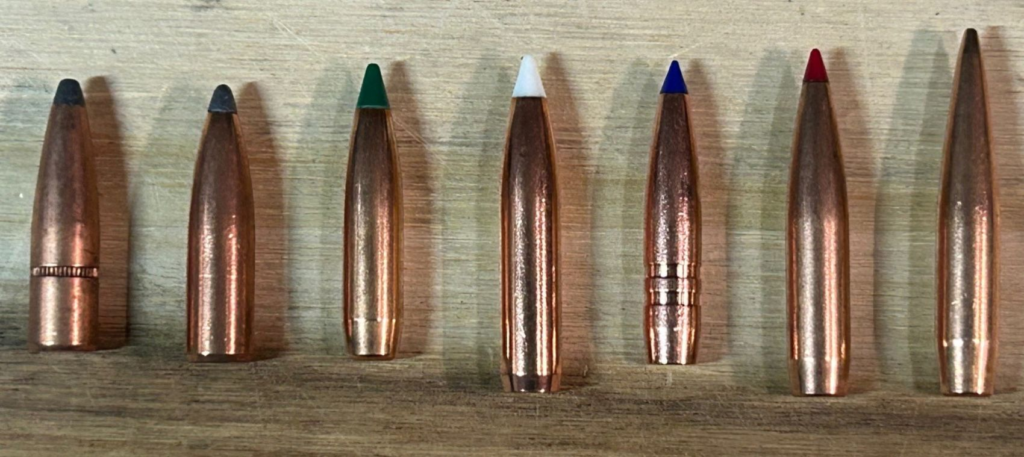
Few topics in the shooting world spark more debate than what actually makes a rifle effective on game. Many discussions begin and end with the cartridge: the 6.5 Creedmoor versus the 7 PRC, the .308 Winchester versus the .300 Winchester Magnum, or the endless argument about what cartridge is “enough.”
To be clear, the cartridge matters. It’s the delivery system. It is responsible for generating the velocity and trajectory that enable the projectile to reach the target and achieve the performance required for the application. But the cartridge isn’t what matters once the bullet reaches the animal. The bullet is the component that actually does the work. Bullet construction largely determines how it mechanically reacts when it encounters tissue, how it creates a wound path, and whether it produces the terminal result the hunter is trying to achieve. The cartridge’s sole role is to deliver that bullet.
This is an important distinction because it changes how we choose our equipment. We’re no longer asking, “What cartridge do I need?” but instead asking the more important questions, “How do I want the bullet to perform?” and “What does a perfect wound channel look like?” If you can answer those questions clearly, you can confidently select the bullet and cartridge that best accomplish your goals.
Start by understanding how the bullet is designed to perform, what velocity it needs to achieve that performance, and what limitations and compromises come with it. Then choose a cartridge capable of delivering that bullet at the velocities and distances where you expect to use it.
First, check the manufacturer’s published minimum impact velocity. It provides a useful baseline for understanding how the bullet was designed to perform. Now determine the muzzle velocity required to maintain that minimum velocity for bullet upset at whatever range is considered the maximum distance you might expect to shoot. Finally, pick a cartridge that comfortably maintains velocity at those extended distances without pushing it to its high-pressure limits.
For example, imagine selecting a 6.5-caliber 142-grain Sierra MatchKing-X bullet. If we understand that the bullet requires at least 1,600 feet per second to upset reliably, we should not design our system around barely reaching that threshold. A responsible approach is to build a margin of error into that performance. If we choose 200 feet per second as that margin, our minimum becomes 1,800 feet per second.
Now we can begin working our ballistics backward. Use a ballistics calculator to check what muzzle velocity is required to maintain 1,800 feet per second at the furthest distance you might shoot. Once you know the required muzzle velocity, you can evaluate which cartridges deliver that performance comfortably without operating near their practical limits.
The cartridge is no longer the starting point. It becomes the final decision, chosen because it delivers the selected bullet at the velocity required to accomplish our goal. Instead of asking, “What is the biggest cartridge I can use?” we ask, “What bullet delivers the terminal result I want, and what cartridge delivers that bullet at the performance level required?”
Why I Started Looking at Bullets Differently
For a long time, I believed what most hunters believed. I heard the industry dogma, repeated by most of the people of the day, and honestly bought into it myself. To the point I’d have a damn good argument with you over it. Good-natured, of course.
This was around the time I first started working in the shooting sports industry; I worked behind the gun counter at a local shop, and I was still pretty wet behind the ears, learning just like everyone else. At the time, the accepted wisdom was pretty simple. If you were hunting deer and elk, you wanted a bullet that held together, retained as much of its weight as possible, and penetrated deeply. If someone recovered a bullet that looked like a perfect mushroom and still weighed about 80% of its original weight, people admired it. That’s what a good hunting bullet was supposed to look like. I believed it too, because that’s what everyone around me espoused. We didn’t just believe it either. We lived and breathed it.
One day, a good friend of mine, Ed Herb, and I decided to do a little experiment. To be fair, it was mostly Ed, he did the heavy lifting, and I was really just the guy at the learning end of the relationship. He gathered up every .338 caliber hunting bullet he could get his hands on and shot them into wet newspaper, digging every bullet out to have a look. We weren’t doing anything particularly scientific. We were just curious.
We looked at three things. How deep each bullet penetrated. How much weight it retained. And what it looked like after it came out. As we laid those bullets out on the table, something interesting happened. Without really thinking about it, I noticed that they just kind of naturally fit into families. There were traditional cup-and-core bullets, which often came apart after passing through the newspaper. There were the bonded bullets, which generally held together and retained much more weight. Then there were the early monolithic bullets that came out looking almost perfect, retaining nearly all of their weight and showing those oh-so-familiar petals. And finally, there was the Nosler Partition, which was and still is kind of in its own unique family.
At the time, those beautiful recovered bullets really spoke to me. After all, that was exactly what the industry said we should be looking for. These were the bullets that had that perfect after-shot shape—a gorgeous mushroom—and penetrated deeply. Because these bullets held together, they also retained a lot of their weight. Surely those had to be the best hunting bullets. It’s what everyone said at the time (and many people still say today), so I bought into it. I believed this was the combination that killed the best, and what was needed to hunt out west.
After this little experiment, I started loading Speer Grand Slams in my .25-06 because they behaved very much like the bullets I had convinced myself were the answer. Then I went mule deer hunting.
I still remember that hunt, because it was the first time I had drawn a mule deer tag, and I was very excited. We were hunting east of Burns, Oregon, in the Malheur Unit. On the first day of the hunt, I had spent the morning helping my employer’s son try to get his first deer. We found some deer, including a couple of small bucks, but just couldn’t get into position to get it done.
Mid-morning, when everyone else was back at camp to chill until the afternoon hunt, I asked my boss’s daughter to drop me off at a closed road so I could hunt by myself. Not very far into the walk, I jumped a nice three-point buck. Before the hunt, I set my sights on shooting a four-point or better, or I would eat tag soup. So I let him pass, but what do you know, right behind him a decent four-point jumps up and starts belining for the thick treeline. I shot him, but he kept running, so I shot him again. He died, but covered considerably more ground than I expected.
When I dressed that deer, something bothered me. The bullets had done exactly what they were designed to do. They penetrated completely and exited the deer. I didn’t recover either of them, so I don’t know exactly how much weight either retained, but based on everything I knew about those bullets, I’m sure they looked just like magazine-cover-worthy examples. The problem was I wasn’t looking at recovered bullets. I was looking at the actual damage done inside the deer. That’s where the real consternation set in. The wound channels were surprisingly small. That’s what made me start asking questions.
The deer had died. There was never any question about that. But I remember standing there wondering if this was really the kind of performance I wanted. That hunt was the moment where I was looking at evidence that tended to refute everything I thought I knew about bullets. It left me standing there scratching my head.
You know, everything in life seems to be a circuitous path, and my rifle and bullet evolution is no different. Working in the industry, I was always (and still am) intrigued by different rifles, cartridges, and bullets. To the point that I was always tinkering. Always trying new things. One of those was using a Remington Model 7 in 7mm-08 for my boss’s kids. I shot that little rifle a lot while getting ready for the hunt, and luckily I helped his daughter kill her first buck toward the end of that same trip. The deer dropped on the spot, and when I opened him up, it was lung soup inside. That was the aha moment. It was quite the dichotomy between the deer I had shot a few days before and hers. I used the type of bullet the industry said was best for hunting, and for the kids’ rifle, I had used a bullet that was often maligned as a poor bullet that created unduly large, messy wounds, but when I looked at what happened at the shot, and when I saw the evidence inside the animals when I gutted them, the differences were stark and dramatically different.
That was the start of the migration to those smaller cartridges and lighter hunting rifles. In fact, I still have that same little Model 7. Karl Durkheimer (my boss and the owner of the store I worked for) gifted me that rifle at the end of the season as a thank-you for helping his kids. We’d managed two deer and two elk with it, and I got lucky enough to inherit it at the end.
Over the next few years, that little Model 7 and then a Sako Finlight in 7mm-08 (which I also still have) racked up an impressive string of animals that all literally dropped where they stood. Even looking back now at that track record, I sometimes wonder why I’m still not hunting with that fantastic little combo.
The wound channels were always dramatically different from what I had seen before. They weren’t excessive, but it was obvious that considerably more damage was being done inside the animals. I still had plenty of penetration for the way I hunted, and even had some exits, but the terminal effect was completely different.
These were some of those defining moments that intrinsically change the way you think. It was through this process that I realized I didn’t actually want the kind of bullet I had been told I needed. For years, I had judged bullets by how pretty they looked after recovery and by how much weight they retained. Now I started judging them by what they actually did inside the animal. As it turns out, those two things aren’t necessarily the same. More importantly, that experience taught me something that has followed me through every part of my career. I still listen to experienced people. I still read what manufacturers publish, but I don’t stop there.
A good friend of mine, Ryan Avery, has a saying that has stuck with me. Trust, but verify. That’s exactly what I had started doing without realizing it. Test ideas. Look at the evidence. But more than that, don’t be afraid to change your mind when the evidence points somewhere else.
The experiences above didn’t just change how I looked at bullets. They changed how I approached learning. And it’s the same approach we’ll take throughout this series. Instead of accepting ideas because they’re popular, we’re going to ask why. In the next article, we’ll look at how different bullets are built, why they’re built that way, what compromises every design makes, and how those design decisions affect what actually happens when a bullet reaches an animal. Because understanding the principles behind bullet performance will always be more valuable than simply memorizing which bullet someone else tells you to buy.
Before we go any further, I want to make one thing very clear. Every bullet can fail. There is no perfect bullet. There can be manufacturing defects. Sometimes what looks like a bullet failure turns out to be an impact-location problem, an angle problem, or a velocity problem. Sometimes bone is encountered in a way nobody expected. Sometimes things simply happen that don’t fit neatly into any theory. If you hunt long enough, you’ll eventually have one of those moments where you walk up to an animal and say, “What the hell was that?” That’s just hunting.
Individual experiences matter, but they also don’t always tell us the whole story. The goal isn’t to build our understanding around a single remarkable success or failure. It’s to look at the larger pattern. The more examples we see, the easier it becomes to separate normal behavior from exceptions.
One more note before we move into the different ways bullets are designed. If you’re hoping this series ends by telling you which bullet is best, you’re probably going to be disappointed. That’s not the goal. I’d rather help you understand enough about bullet construction and terminal performance that you can look at a bullet you’ve never seen before and begin asking the right questions about how it’s likely to behave. To me, that’s a much more valuable skill than simply memorizing my favorite bullet.
Before We Talk About Bullets, We Need to Talk About Problems
Before we start talking about how bullets are built, I think we need to step back for a minute.
Every bullet has a design, and that design isn’t something that just happens. Every feature of a bullet exists because somebody was trying to solve a particular problem. One of the easiest ways to see this is by looking at one of the most influential hunting bullets ever designed: the Nosler Partition.
John Nosler was on a Canadian moose hunt when he encountered exactly the kind of failure that would eventually lead to the Partition. At close range, his bullet struck the moose’s shoulder and encountered heavy resistance. It upset so violently that it came apart before penetrating deeply enough to reach the vital organs. That experience stuck with him. Instead of simply blaming the bullet and moving on, he started asking why it had happened.
The problem wasn’t that the bullet failed to upset. It upset too much, too quickly. The front of the bullet lost structural integrity against the shoulder before enough of it could continue into the chest. Nosler went home and designed a bullet that separated those two jobs: let the front upset, but protect the rear so something substantial would keep penetrating.
In Nosler’s day, most hunting bullets still relied on relatively simple cup-and-core construction, and many did not have enough structural control to prevent them from coming apart under heavy resistance. Don’t get caught up in the name; I’ll circle back and cover cup-and-core construction in the next article. What matters here is that the bullets Nosler was using expanded too violently at close-range impact velocity and failed to penetrate deeply enough.
Rather than allowing the entire bullet to behave the same way on impact, he physically separated the front and rear lead cores with a partition inside the jacket. The front of the bullet could still upset, but if that front section came apart, the rear core remained intact, allowing the bullet to continue penetrating.
It’s a remarkably simple idea, and it’s still relevant today. Countless bullet designs have been introduced since then, and the Partition has been refined over the years, but the basic engineering concept remains the same. John Nosler identified a problem, then he went home and designed a bullet to solve it. That’s really the point. Every bullet you see today exists because an engineer or bullet designer (they’re not all engineers!) was trying to accomplish something.
A hunting bullet isn’t designed the same way as a match bullet either, because each style of bullet is trying to accomplish a different goal. When an engineer sits down to design a hunting bullet, one of the first questions he has to answer is: How do I want this bullet to perform after it reaches the animal? Should it penetrate deeply? Should it upset quickly? Should it retain most of its weight? Should the front of the bullet fragment, or should it all stay together? Every one of those decisions changes how the bullet behaves, and every one of those decisions involves tradeoffs.
Look for Patterns, Not Perfect Bullets
Before we go any further, I should probably clarify one piece of terminology. Throughout this article, I’m going to use the word upset. Technically, that’s the correct term for the way a bullet changes shape after impact. Most shooters use words like “expand” or “mushroom,” and we understand what they mean, but when we’re talking about bullet mechanics, “upset” is the more accurate term.
Now let’s compare that hunting bullet to a match bullet. The engineer designing a match bullet usually isn’t thinking about terminal performance at all. His job is to produce a bullet that flies as accurately and consistently as possible. If he’s designing a short-range benchrest bullet, ultimate aerodynamic efficiency may not even matter very much. Those bullets are often flat-based because accuracy at relatively short distances is the priority.
A long-range match bullet is a different problem entirely. Now the engineer is trying to minimize drag and make the bullet fly as efficiently as possible. That leads to long, sleek noses, secant ogives, and long boat tails because those features improve aerodynamic performance over extended distances. The problem changed, so the design changed. And generally, there’s little consideration given to how the bullet will upset.
Now think about a varmint bullet. The engineer designing that bullet has another completely different objective. Generally speaking, he wants the bullet to upset very rapidly and fragment extensively on impact. Anyone who’s spent time shooting prairie dogs understands exactly what that bullet was designed to do. Again, different problem, a different solution.
This is why it’s so important to understand that bullets aren’t all trying to accomplish the same thing. Every design represents a series of compromises. A bullet built to maximize penetration won’t necessarily be the most aerodynamic. A bullet optimized for long-range flight may not behave the way you want on game. A bullet designed to fragment violently on a prairie dog would probably be a poor choice for an elk. None of those bullets are wrong. They’re simply solving different problems.
That’s the framework I want you to keep in mind as we move forward. Before we ask whether a bullet is “good,” we first need to ask a much better question: What problem was the designer trying to solve? Once we understand that, the bullet’s construction starts making a whole lot more sense.
In the next article, we’ll start with the original cup-and-core bullet and work through the different ways designers have answered that question.
Related Reading
- Understanding Bullet Design, Part 2: Bullet Construction — A detailed look at cup-and-core, bonded, partitioned, monolithic, and match bullets, and how their construction influences terminal behavior.
- Understanding Bullet Design, Part 3: Terminal Ballistics — How impact velocity, upset, fragmentation, penetration, temporary cavity, and permanent cavity determine what happens after a bullet reaches an animal.
- What Is Ballistic Coefficient? — How bullet shape and drag influence velocity retention and why that matters once we begin thinking about impact velocity downrange.