
Density altitude is a term you’ll hear frequently in long-range shooting, but what does it actually mean, and why does it matter?
The simplest way I explain density altitude is that it’s a single number that tells your ballistic solver how thick or thin the air is that your bullet will be flying through. That number accounts for the effects of atmospheric conditions, including elevation, temperature, station pressure, and humidity. Elevation and temperature are generally the biggest factors shooters notice, while humidity usually plays a relatively small role. But why do we need to know how dense the air is?
It Started With Aviation
The concept of density altitude comes from aviation, where pilots need to understand the density of the air their airplanes are flying through. An airplane depends on air flowing over its wings to generate lift. When the air becomes less dense, the wings generate less lift at the same airspeed and conditions. Knowing the density altitude helps pilots understand how their aircraft will perform.
A bullet is also flying through the atmosphere, but instead of being concerned primarily with lift, we’re concerned with aerodynamic drag. The denser the air, the more drag the bullet experiences as it travels downrange. That drag causes the bullet to lose velocity more quickly, which changes its trajectory. In thinner air, the bullet experiences less drag, retains velocity longer, and generally requires less elevation correction at longer distances. Density altitude gives us a convenient way to describe those atmospheric conditions with a single number.
Density Altitude Isn’t Your Actual Elevation
This is where people sometimes get confused. Your physical elevation above sea level doesn’t change unless you actually move somewhere else. Density altitude, however, can change throughout the day as atmospheric conditions change.
For example, I live at approximately 700 feet above sea level. Yet when shooting in that same area, I’ve seen density altitude readings ranging from negative 1,000 feet to more than 3,000 feet. That’s a difference of over 4,000 feet in density altitude without changing my physical elevation.
The higher the density altitude, the thinner the air. The lower the density altitude, the denser the air. And because air density affects aerodynamic drag, those changes can affect the elevation correction needed to hit a target.
How Do You Determine Density Altitude?
There are several ways to obtain density altitude, and you don’t necessarily need expensive equipment. You can use a weather station that provides the atmospheric information necessary to calculate density altitude. A handheld weather meter, such as a Kestrel, can measure conditions where you’re shooting and provide the number directly. You can also use a density-altitude chart to estimate the value from the appropriate atmospheric conditions.
All three approaches can work well. The important thing is that your density-altitude information represents the conditions where you’re actually shooting. If you take a reading at one elevation and then travel several thousand feet higher, that original reading may no longer be appropriate. The same applies when temperatures change substantially throughout the day.
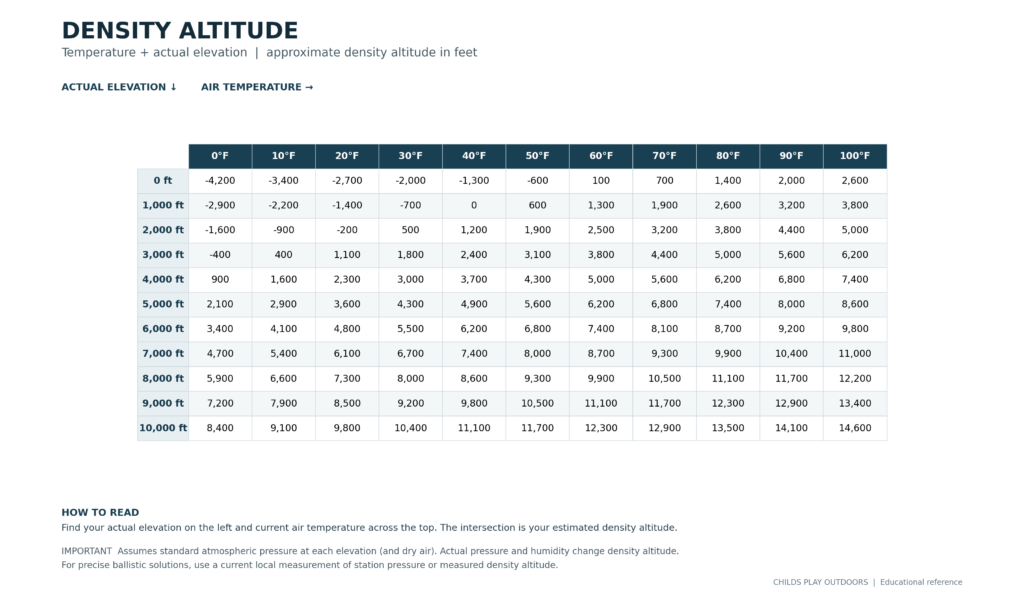
This chart estimates density altitude using elevation and temperature, assuming standard atmospheric pressure. Actual density altitude may vary with weather conditions. However, even a 500-foot difference generally produces only a small change in ballistic solutions at typical shooting distances. The effect becomes more significant as distance increases.
A ballistic solver can use density altitude directly, or it can calculate air density from individual atmospheric measurements, depending on how it’s configured.
When Should You Check Density Altitude Again?
Density altitude doesn’t necessarily stay constant throughout the day. You might arrive at a range on a cold morning, take your reading, and begin shooting. By early afternoon, temperatures may have risen considerably, changing the density of the air even though you haven’t moved.
As a general guideline, I start paying closer attention when density altitude changes by roughly 1,500–2,000 feet. At extended shooting distances, that much change can alter your ballistic solution by several tenths of a MIL, potentially enough to miss a target. The actual difference depends on your cartridge, bullet, and shooting distance.
For that reason, I often recommend taking a density-altitude reading in the morning and another in the afternoon. If you’re changing elevations or experiencing substantial temperature changes, it’s worth checking again.
When I’m competing, I may check several times throughout the day. Winter matches in the South can be particularly interesting because temperatures sometimes change dramatically between the first stage and the last. I’ve seen elevation solutions change by a couple tenths of a MIL as the conditions change.
Understanding Why It Matters
You don’t need to understand atmospheric equations or perform complicated calculations to use density altitude effectively. You simply need to understand that the density of the air affects how your bullet flies, and that density altitude provides a convenient way to represent those conditions.
Higher density altitude means thinner air and generally less aerodynamic drag. Lower density altitude means denser air and generally more drag. Knowing your density altitude allows your ballistic solver to account for those differences when calculating a trajectory. And just as importantly, understanding when that number has changed enough to matter helps you recognize when it’s time to update your ballistic solution.
That’s really all most shooters need to understand to begin using density altitude effectively.
To better understand how a bullet moves through the atmosphere, read What Is a Ballistic Coefficient? It explains how bullet design affects aerodynamic drag and how efficiently a bullet retains velocity as it travels downrange.
To understand how atmospheric conditions become more important when shooting at longer distances, read What Scope Do I Need for Hunting? It explores the features that matter when selecting a scope for different shooting distances.